
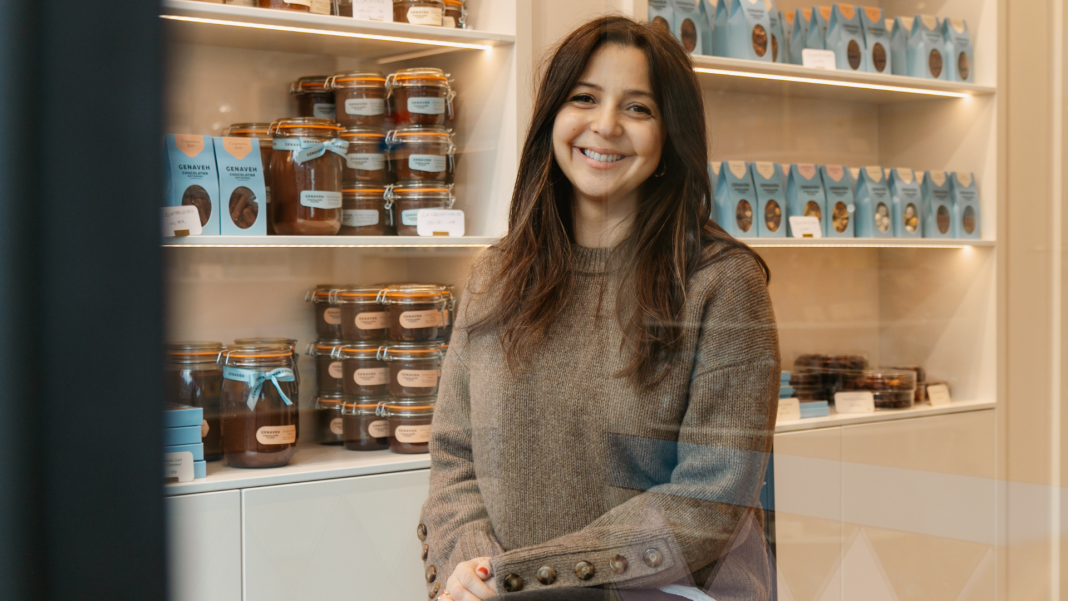
At the head of Genaveh since 2017, Alexandra Kahn has breathed new life into an emblematic Luxembourgish chocolate house, all without being a trained artisan.
Today, she is the face associated with the soft blue of her gourmet brand. A graduate of Paris-Dauphine Master’s in Finance followed by a Master’s in Entrepreneurship, Alexandra Kahn began her career in banking, continued in logistics in Hong Kong, before joining marketing consulting in the luxury sector.
“What I was doing pleased me, but it didn’t truly excite me. So at some point I asked myself: what am I going to do to really be passionate about what I do?,” she recalls. In order to clear her mind, Alexandra kept her hands busy: she returned to Paris and started baking at her mother’s home. Orders from friends began to come in, then from friends of friends… “I wanted to get my hands into the dough, to do something concrete, with quick results that make people happy.”
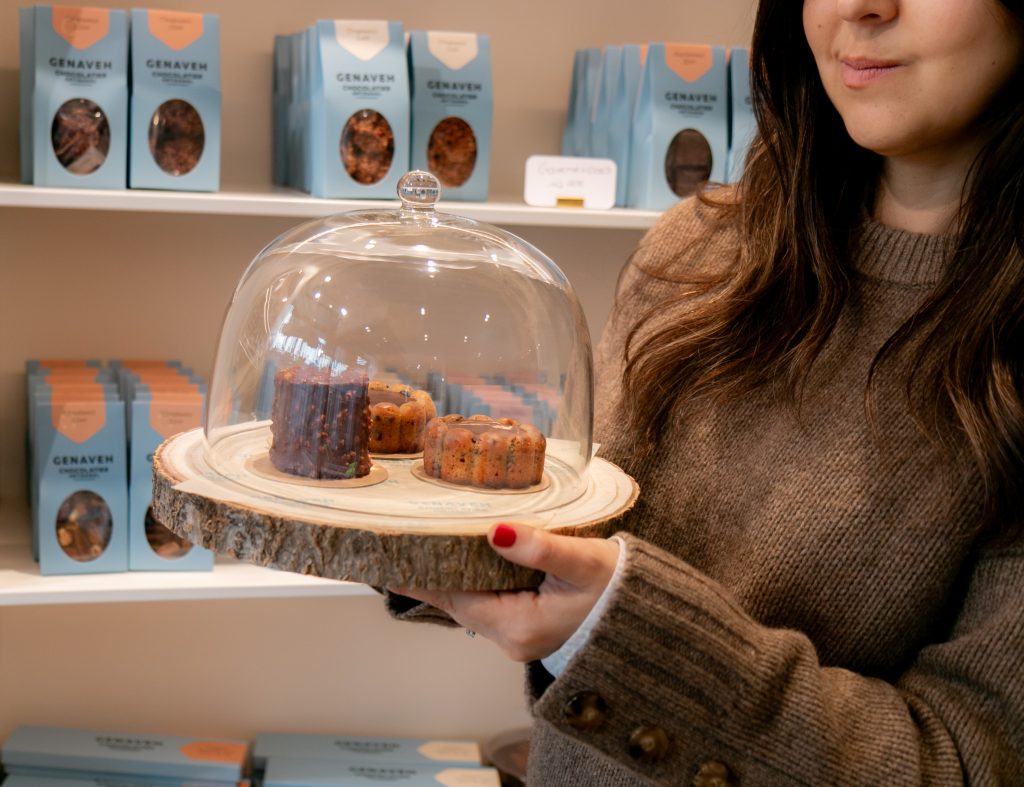
She completed several internships, notably with Cyril Lignac, then enrolled at Ferrandi to prepare a CAP diploma. That is when her father, based in Luxembourg, called her. A small chocolate factory is for sale. “He told me: ‘Alex, instead of starting everything from scratch, wouldn’t you like to buy a chocolate factory?’” What if destiny was sending her a sign? It is a nice coincidence that her grandfather owned several businesses in Luxembourg and notably opened the country’s first Leonidas store.
Challenging business transition
The chocolate factory in question is Genaveh, founded in 2005 by Geula Naveh, a prizewinning entrepreneur who also changed careers, and started in her kitchen before settling on Route d’Arlon in Strassen. But when Alexandra arrived, the situation was fragile. “She was really the soul of the chocolate factory, she was the chocolatier, she was there every day.” Her gradual absence weakened the business. Quality declined, along with the image. The boutique had already moved to Steinfort by the time Alexandra arrived, but the brand was going through a delicate period.
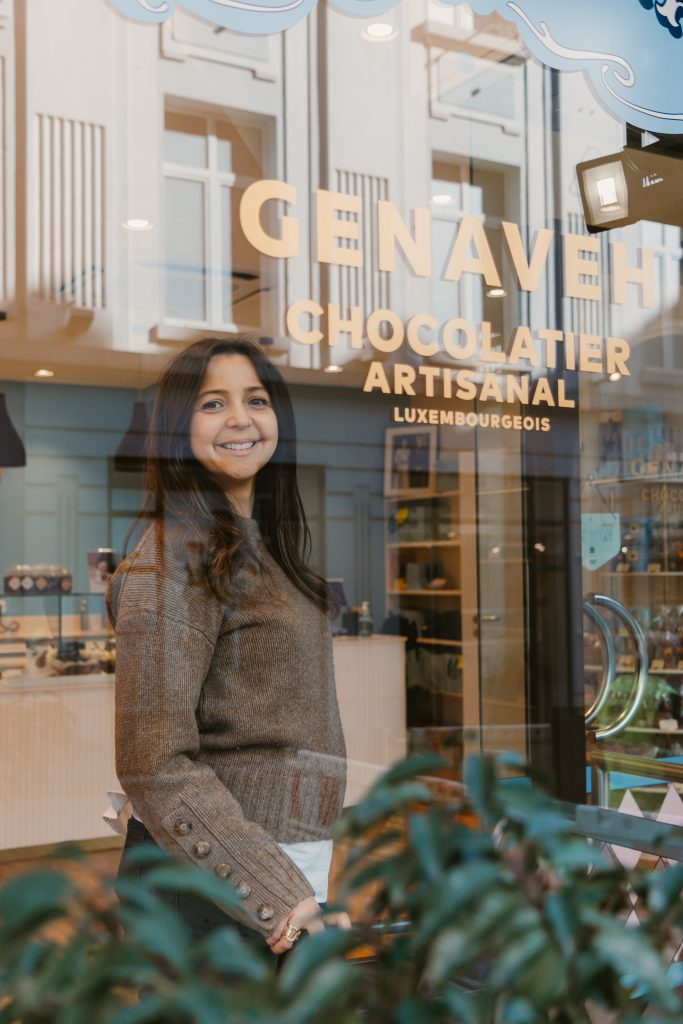
“The employees kept working even though they were no longer necessarily being paid. They were waiting for a buyer.” The takeover was finalised at the end of 2017, after nearly a year of negotiations. Alexandra did not buy the company, which was financially struggling, but took over its assets: the recipes, machines, employees and the brand. “We did consider changing the name. It’s difficult to pronounce, no one really knows how to say it. But there was a whole heritage. It’s a chocolate factory run by women. We wanted to pay tribute to that.”
Transparency and engagement
Alexandra arrived shortly before Christmas with humility and determination. Faced with a seemingly impossible amount of orders for such a small team, she moulded Saint Nicholas figures in the evenings to meet deadlines. “I chose from the outset to be extremely transparent, with an open-door policy, and to work hand in hand with them.”
Christmas represents 40% of annual revenue and workload. “I had friends who came from Paris every weekend, groups of ten, from 8 am to 7 pm, filling boxes. My family was also by my side. Luckily they were there, otherwise we would never have delivered on time.” Once the urgency passed, strategy gradually took shape. She modernized the packaging and adopted a distinctive blue, “To change a bit from what you usually see in traditional chocolate making.” Then came structuring production by recruiting. “At first, I didn’t have a head chocolatier. We could reproduce, but we couldn’t evolve. So I recruited Romain, so that we could develop our recipes.”
Select ingredients
A major turning point came three years ago: the creation of tailor-made chocolate couvertures. “Before, we selected very good couvertures, but any chocolatier could order the same ones.”
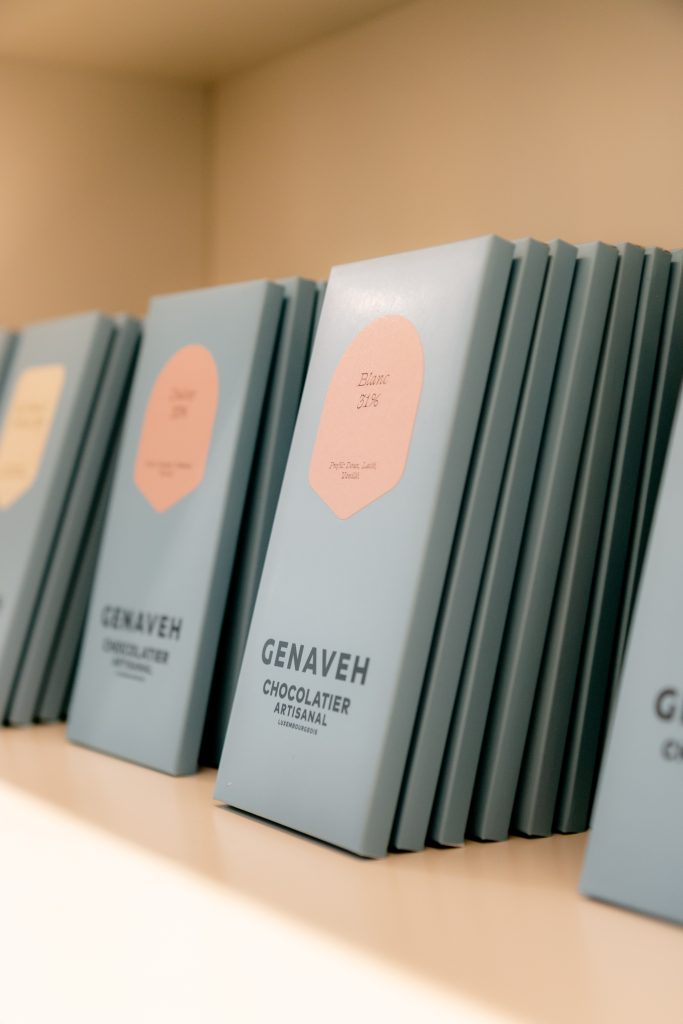
Now, the house works with a French producer for dark chocolate and a Swiss one for milk chocolate. “We selected the beans together, the origin, the fluidity we wanted, the taste we wanted. White sugar was replaced with unrefined sugar, soy lecithin with sunflower lecithin.” The cocoa beans for the dark chocolate come from Peru. “I went there, I saw the plantations, the conditions in which they work, the work being carried out on site.” The milk chocolate incorporates cocoa from São Tomé and Príncipe, an island recognised for its biodiversity, and the milk used by the Swiss supplier comes from “within 20 kilometres of their laboratory.”
Kahn wants to have greater impact than just labels and selects suppliers carefully. “Our Peruvian beans are organic and fair trade. But since the rest of the supply chain and our other ingredients are not necessarily organic, our final chocolate does not carry those labels. What matters to us is knowing exactly where the beans come from and under what conditions they are produced.”
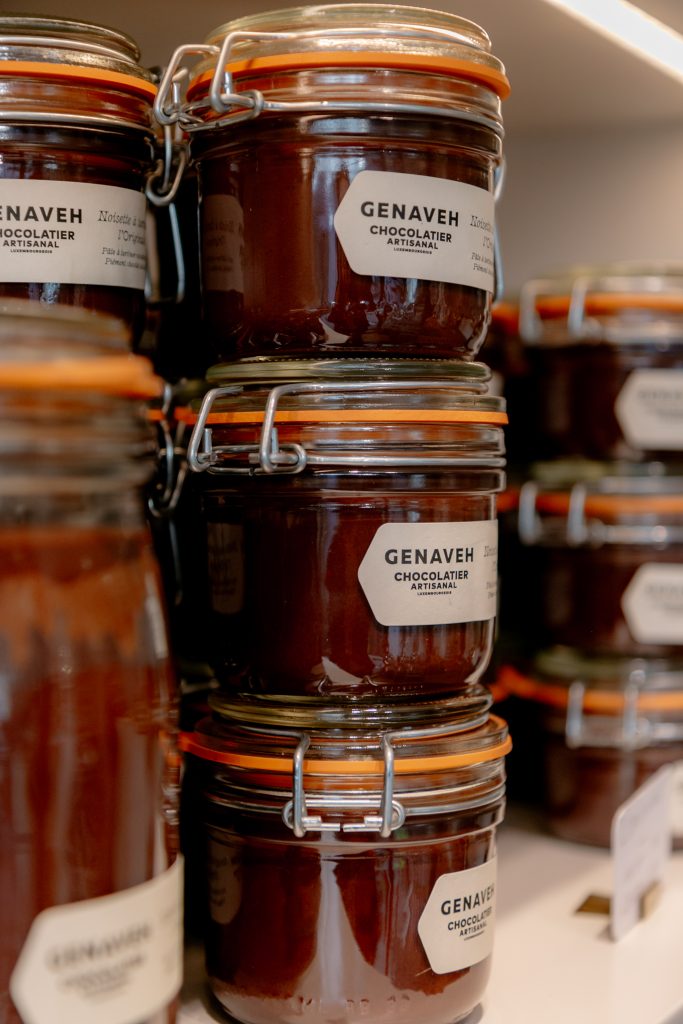
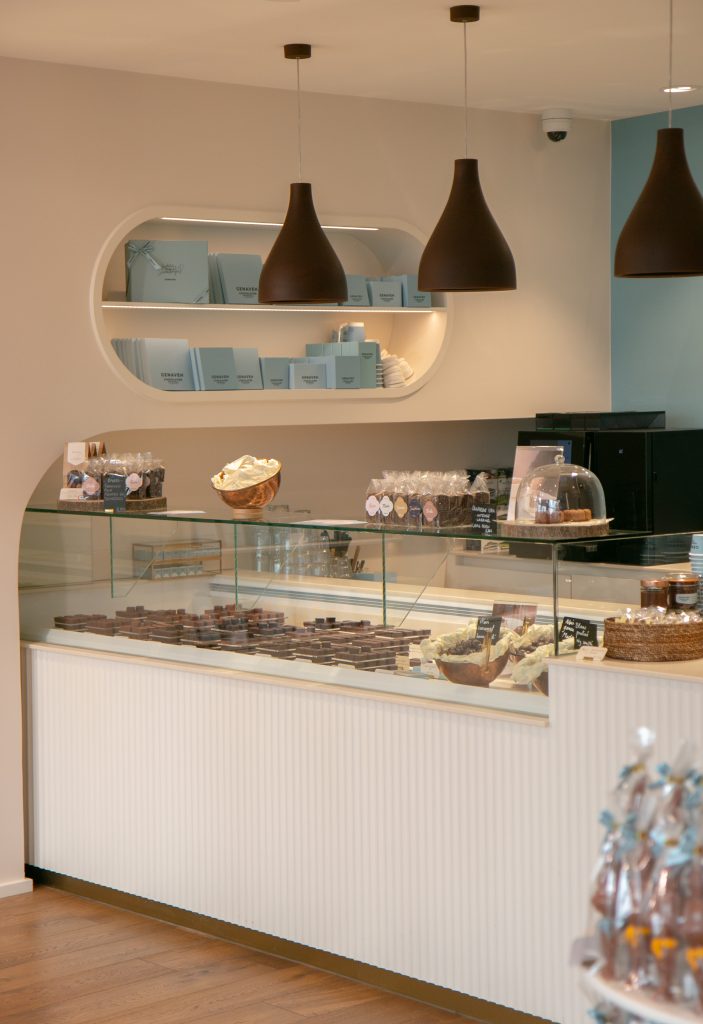
Genaveh is now stocked at La Grande Épicerie du Bon Marché in Paris, as well as in a few delicatessens in London and Amsterdam. “I kept sending packages, sending packages… and one day it worked.” While international expansion is developing in a controlled way, Luxembourg remains the main market, and Kahn is also expanding into corporate gifts and personalised orders for companies. In 2022, the year she obtained the title of official supplier to the Grand Ducal Court, she opened a first boutique in the centre of Luxembourg City. “We had planned two tables outside, but our clients asked us to add more so they could sit down.” The place naturally evolved into a tea room, with Saturday breakfasts and hot chocolate.
Revenue multiplied by eight
In Steinfort, the workshop installed since the beginning has also continued to expand. “We went from 400 to 800 square metres during Covid, […] and last September, an additional 500 square metres were added.” They created a pastry laboratory, as well as a space dedicated to workshops for companies and individuals and, above all, a second tea room. She also added new creations around chocolate. Since her takeover, revenue has multiplied by eight. “There were five of us when I arrived. Today, we are between 25 and 30 depending on the season.” But ambition remains measured: “Since we want everything to remain artisanal, we won’t be able to grow indefinitely, but we can always improve our processes.”
She no longer blushes about not being a trained artisan. “It’s a different model from what we usually see. I think that working the way I do allows a bit more perspective on both sides. The chocolatier is really focused on their subjects and I am really focused on mine. We meet on many things because we work together, but indeed, I think that a chocolatier who develops his chocolate factory like mine can no longer work purely as a chocolatier. It requires so much time and energy: sales, administration, HR, purchasing…”
“Chocolate is all about positivity. Not many people come to complain about chocolate!”
Today, Kahn continues to trust her instinct for what comes next, without venturing into projections. “We’ve reached a place I’m quite happy with,” she admits. “And besides, chocolate is all about positivity. Not many people come to complain about chocolate!” she laughs.
This article was published in the 9th edition of Forbes Luxembourg.
Read more articles:
Pascaline Smets: The Art Of Fashion Curation
Europe Must Win The Space Race
€100 Million Distribution Milestone For Fondation de Luxembourg
