
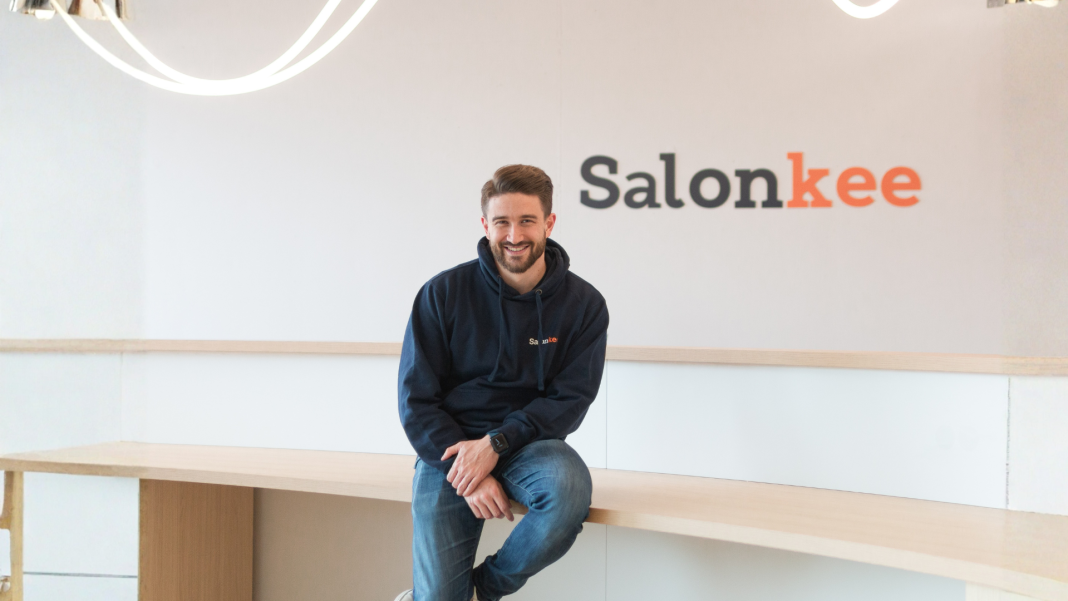
Luxembourg scale-up Salonkee recently surpassed a critical milestone, reaching over 10,000 European salons on its platform. It has also launched a new B2B service. CEO and co-founder Tom Michels explains.
What started off as a simple frustration for Tom Michels has grown into one of Europe’s leading vertical SaaS platforms for the hair and beauty industry. Neither Michels, who studied computer science and business in Germany, nor his four other co-founders had any particular interest in this industry per se, rather “we just wanted to book our appointments online,” Michels explains.
The team began with a “very lean process”, reaching out to salon owners to understand their industry challenges and whether they were using software to alleviate their pain points. From these discussions, Michels and the team realised “there was a big opportunity to really bring this whole industry into the digital age, and [we could] build the best software for them so they could manage their whole business, not just bookings, with software.”

Such feedback was critical for Salonkee to launch in 2017. Its software helps power salons not only with their booking management but can be fully customisable and includes options for payment integration, newsletters and loyalty programmes. The strong sales force continues meeting with salon owners and potential clients to dig deeper into their needs. This continuous feedback loop and listening to customers has been key to Salonkee’s success.
B2B expansion
Since launching in 2017, Salonkee has become a rising Luxembourg, and European, success story. In June 2023, the team raised €28m in its Series-B funding to further extend its European market penetration. This announcement followed a €6.2m Series-A fundraising in 2021 and a seed investment of €1m in 2019.
In addition to surpassing its milestone of reaching 10,000 European salons over the past year, Salonkee also launched a B2B shop in Q4 2025 which salons can use to restock their products. “We’ve made it easier to buy those products, and it’s directly integrated within the point-of-sale system and the stock management,” Michels explains.
It’s with these new B2B functionalities that Michels envisions “big potential”. After rent and salaries, professional products represent the third largest expense for salons. Yet ordering them is often fragmented and manual, even spread across a variety of suppliers and websites.
Salonkee’s solution brings everything under one umbrella. Through partnerships with wholesalers, salons can now reorder shampoos, styling products, tools and equipment directly through the platform. “We think that we can offer very attractive prices to salons and a very easy ordering process,” Michels adds.
These purchases are linked to real-time data and can enable predictive stock management. “We link to your stocks, so we can predict what you’ll need in the future, and then you can just buy in a couple clicks, all from one place,” the CEO says. When a shipment arrives, products are automatically added to the salon’s inventory, eliminating the issue of stock discrepancies which can arise if an individual fails to scan shipments into their stock manually, for instance.
Though still early, the company sees significant potential in the B2B shop, both in terms of value for the salons but also as a long-term revenue driver.
Scaling across Europe
Luxembourg currently remains Salonkee’s strongest market, with approximately 70% penetration, according to Michels. “There are around 330,000 salons in the Benelux and DACH [Germany, Austria and Switzerland] regions, and we have 10,000 now,” he explains. “The market is so big, and there’s so much more to do.”
He adds that Salonkee is approaching 20% penetration in Belgium, and the focus moving forward will be to become a market leader in Germany, the largest market for beauty and salon services in Europe. “But we are far from 20% of the overall European market, or the six countries we are in.”
One of Salonkee’s competitive advantages is being headquartered in Luxembourg. From this base, the company supports customers in several languages, while salespeople operate across the other European locations. The Luxembourg staff also includes developers and marketing.
“From Luxembourg, you can serve multiple countries”
“From Luxembourg, you can serve multiple countries,” Michels explains. “We see some competitors, if they go from France to Germany, they have to rebuild the whole structure in Germany. We don’t. We can do everything from here except the sales, which are done on the ground, in person.”
AI and entrepreneurship
While Salonkee sees artificial intelligence (AI) as a booster for coding, the company is also exploring how it could further use the technology within its software. Michels says it could be an interesting use case to determine whether AI could assist salons in reactivating their inactive clients—“to not be annoying, but to find the right moment to contact the right customer to say we miss you or your next appointment is up.”
Salonkee is also operating within an increasingly complex regulatory environment; data protection, the Digital Services Act, and rules around AI require constant attention. “It’s just a lot of things to keep up on that might make operating in Europe maybe slightly more challenging than it should be,” Michels adds.
Michels, who was around 25 years old when he began developing the concept that would become Salonkee, says he tends to work around 60 hours per week, which can include weekends and evenings. Nevertheless, he likes to encourage other young entrepreneurs to get started early if they have the idea and the drive. “You don’t have any big obligations at that time, you might not have children yet, you might not have a house or a loan to pay,” he adds. “You might not have much money, but the thing you need is time.”
He suggests that if an initial idea doesn’t take off in a couple years, at a younger age it’s still easier to get a job, an option that’s easier than, say, working a job for 10 years and then trying to launch. Ultimately, if the idea and drive is there, young entrepreneurs should just go for it: “You have to have a certain naivety initially to get started, but that’s good because otherwise, you might not start anyway.”
This article was published in the 9th edition of Forbes Luxembourg.
Read more articles:
Sisley: Where Science Meets Elegance
From Heritage To Horizon: Reinventing Family Succession
People Engagement, The Missing Piece Of AI Performance In Luxembourg?