
This Luxembourg startup is accelerating pharmaceutical breakthroughs by conducting drug research in orbit. With a maiden mission in space scheduled for 2027, Exobiosphere is proving that the future of medicine lies beyond Earth.
Since its founding in Luxembourg in late 2024, Exobiosphere, a venture bridging the space industry and pharmaceutical sector, has achieved what few startups accomplish in their first year: €3 million raised in a seed round, victory in the regional Startup World Cup, signed paying clients, and securing a spot aboard humanity’s first crewed commercial space station, Vast’s Haven-1.
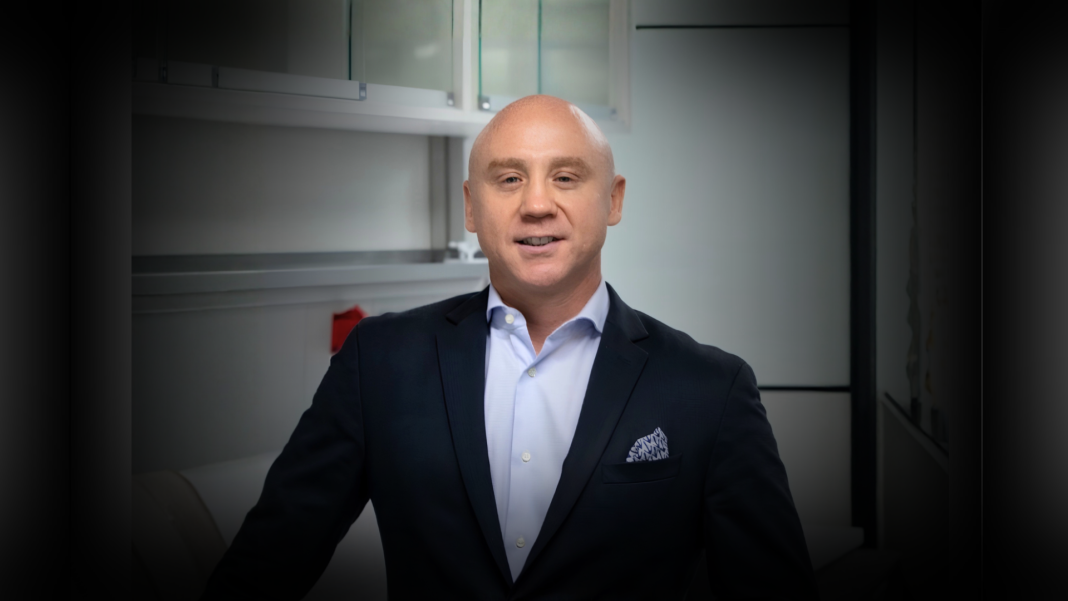
Led by CEO Kyle Acierno, engineer Dr Olivia Borgue and scientist Dr Bruno Santos, the company now counts some twenty employees and is pursuing a particularly promising field: the development and discovery of ‘cures from space’, with the prospect of breakthroughs impossible to achieve on Earth.
The emergence of this niche sector stems from a fundamental problem: pharmaceutical research today is slow, expensive, and inefficient. Drug development timelines routinely exceed a decade, cost billions, and fail at rates surpassing 90%.
“We can speed up the entire drug discovery process”
Space offers a radically different environment. In microgravity, cells age faster, neural development accelerates, cancer resistance heightens, and immune responses alter. This creates opportunities to identify new treatments for premature aging, neurodegenerative diseases like Parkinson’s, autoimmune disorders, and more effective cancer therapies. “We can speed up the entire drug discovery process,” Acierno explains.
Commercialising space research
Research has been conducted aboard the International Space Station for three decades. Yet the process has remained slow and prohibitively expensive, relying on astronaut intervention and yielding limited statistical data. Only recently have advances in robotic miniaturisation and a new generation of computing chips enabled private commercial space companies to make this practical.
“Our system is basically the size of a carry-on suitcase or a big microwave”
“Our system is basically the size of a carry-on suitcase or a big microwave,” Acierno says. “Inside, we have numerous robotic systems, a microscope and plate reader, a liquid handler, and actuators.” The all-in-one laboratory, dubbed the Orbital High-Throughput Screening System (OHTS), can conduct thousands of simultaneous tests through multiple automated robotic systems, AI-enhanced bioinformatics, and real-time data transfer to ground-based control systems.
Exobiosphere positions itself as the first Contract Research Organization (CRO) firm providing specialised biomedical research services and dedicated entirely to space-based drug discovery.
Simple model
The model is straightforward. Scientists provide the cells and compounds they wish to test; Exobiosphere supplies the platform and expertise to prepare the mission. “We organise everything and provide a turnkey service,” Acierno explains. “We ship up their experiment, put it inside our system, which is fully autonomous and conducts the entire experiment remotely. Then it comes back down and we deliver not only the cells back to our customers, but also the data.”
The approach has already won over two prominent partners: Notre Dame University in Indiana and Cedars-Sinai Medical Center for Regenerative Medicine, one of Los Angeles’s largest and most prestigious hospitals, and a leader in space research. More are expected to follow in the coming months.
Modern pharmaceutical research, increasingly powered by AI, demands ever-larger volumes of high-quality data. “We firmly believe that by conducting tests in microgravity, we’ll get accelerated, high-quality data they can use,” Acierno says. The goal is to enable complex three-dimensional disease modelling and to identify effective new therapies.
Investor interest
Investors have taken notice. Backing includes Luxembourg’s Expon Capital alongside South Korea’s Boryung and Japan’s Space Data. The €2 million seed round was led by the pan-European venture fund Expansion Ventures. More recently, a $1.4M seed extension round led by Cedar-Sinai Technology Ventures demonstrates the traction from Europe, Asia and the US. Exobiosphere plans to launch another funding round in April 2026. “Financially, we’re in a strong position, but we’ll soon raise another round to further strengthen ourselves and ensure we have a dominant position going into 2027 and 2028,” Acierno says.
Profitability often remains a distant goal for space startups, burdened by immense development costs. Exobiosphere expects a different trajectory. “We are developing a very small payload, so we don’t have enormous costs,” Acierno explains. “We do intend to build larger systems and if we decide to, of course our R&D costs will increase, but our goal is to generate revenue all along. We intend to position ourselves as a growing and highly lucrative business from the outset.”
Supportive ecosystem
According to Acierno, Luxembourg “excels at supporting innovative companies and space ventures specifically,” and will remain Exobiosphere’s headquarters. Yet the company is already positioning itself globally. It has opened an office in Los Angeles, a strategic move in an ecosystem where much of the commercial space industry clusters. “In space, America is the biggest market, so it’s crucial to have a presence in the US and the ability to serve it.”
The next main milestone is the maiden voyage to space. Under an agreement announced in April 2025 with American company Vast, Exobiosphere will install its OHTS onboard Haven-1, the world’s first crewed commercial space station. There, it will conduct its first autonomous cellular culture experiments in microgravity. Liftoff to low Earth orbit is scheduled for March 2027.
Yet Exobiosphere’s ambitions extend beyond contract research. The company plans to launch a bioinformatics service to provide advanced data analysis and insights, a natural next step given its access to unprecedented microgravity datasets. Further out, the vision becomes even more ambitious: to evolve into a biotech company developing its own therapeutics centred on longevity treatments. “We’re going to contribute to a revolution in drug discovery in the coming years,” Acierno reflects.
This article was published in the 9th edition of Forbes Luxembourg.
Read more articles:
The “Pearl” Of Luxembourg’s Grund
Beyond Banking: The Art Of Meaning
Europe Offers Investors A Powerful Diversification Opportunity
