
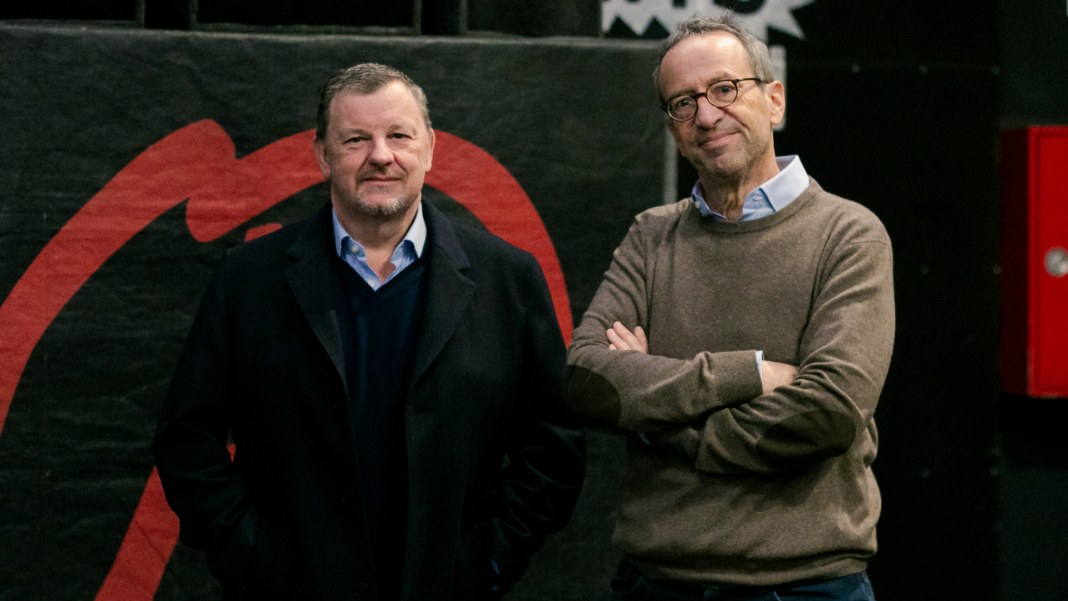
When Den Atelier’s founders started organising gatherings, they simply wanted to throw parties. Thirty years later, they have turned a former garage into a legendary venue, renowned far beyond Luxembourg’s borders.
It’s a Monday at noon, at Bella Napoli in Luxembourg’s Gare district. At a table near the wall, Laurent Loschetter and Patrick, known as Petz, Bartz are waiting for me. “Do you know why we asked you to meet us here? We have so many memories in this place. We always used to come here with the artists after concerts,” Petz tells me. Laurent continues: “Believe it or not, this is where Jane Birkin had her very first limoncello. Back then, artists still went out for dinner after their shows.”
Their friendship dates back to high school, as does their love of a good party. With a dozen equally enthusiastic friends, they began organising teenage parties under the name “The Party Team.” At the time, apart from village balls, it was hard for 16-year-olds in Luxembourg to go out together and, incidentally, to meet girls.
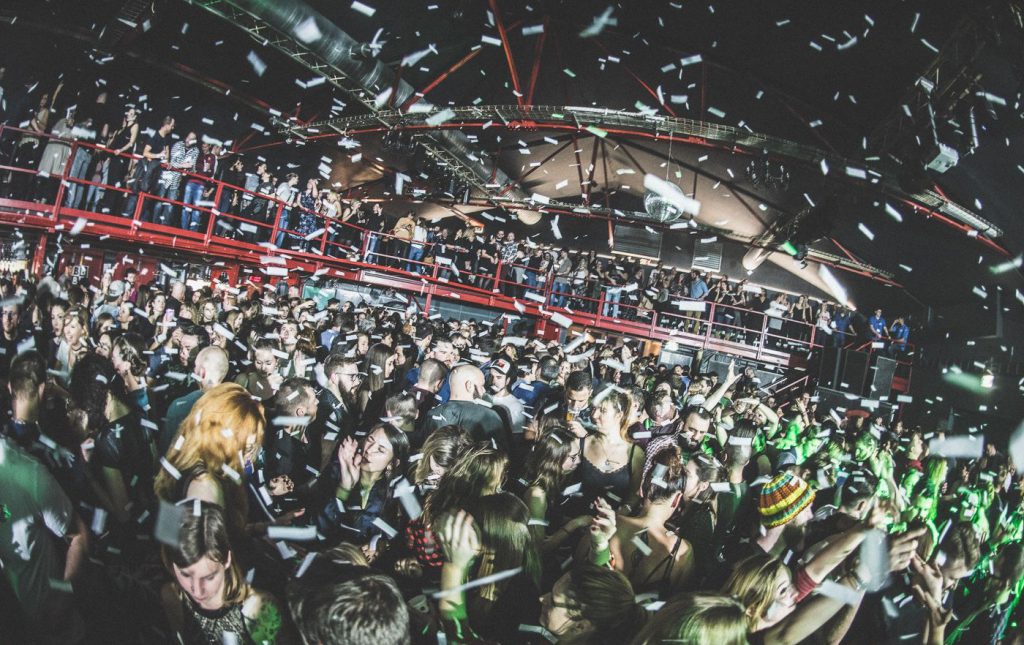
“It started with the idea of celebrating the birthdays of several friends who were all born around the same time. Then we ended up organising about ten parties a year across the country, travelling in my father’s van, packed with our sound system and lights,” Laurent recalls. “We became more and more well known. Youth centres would call us, and we’d take over municipal halls. In the end, there were 4,000 to 5,000 people at our parties,” Petz adds. Hesperange, Walferdange, Kockelscheuer… Memories flow as the duo reels off the list of towns where they made an entire generation dance.
“In the end, there were 4,000 to 5,000 people at our parties”
A “party team” with vision
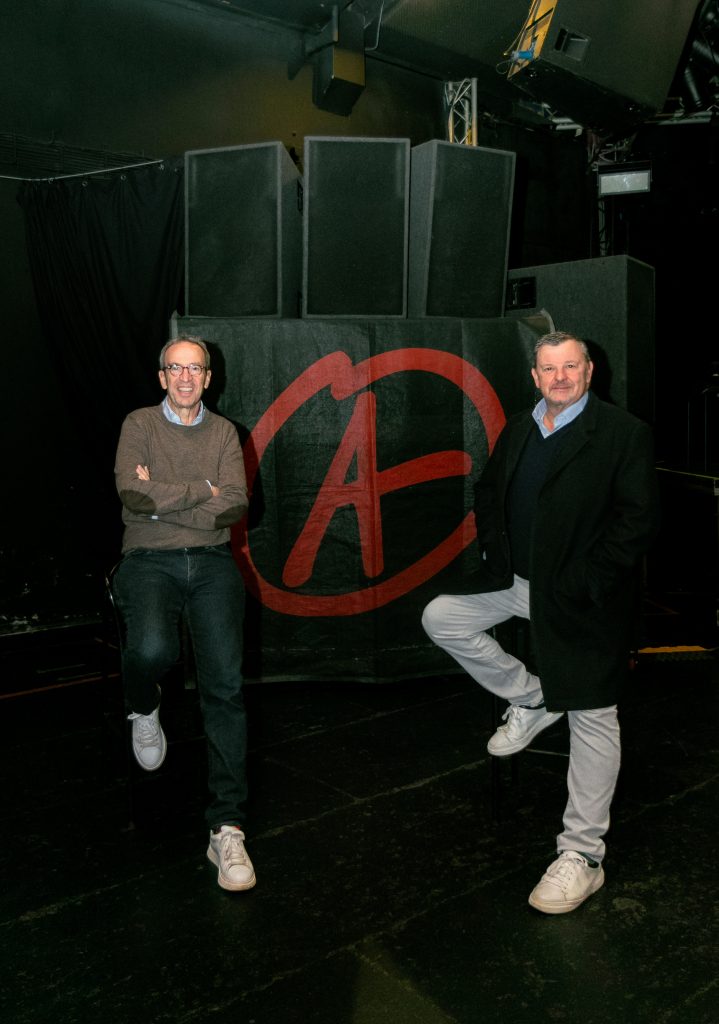
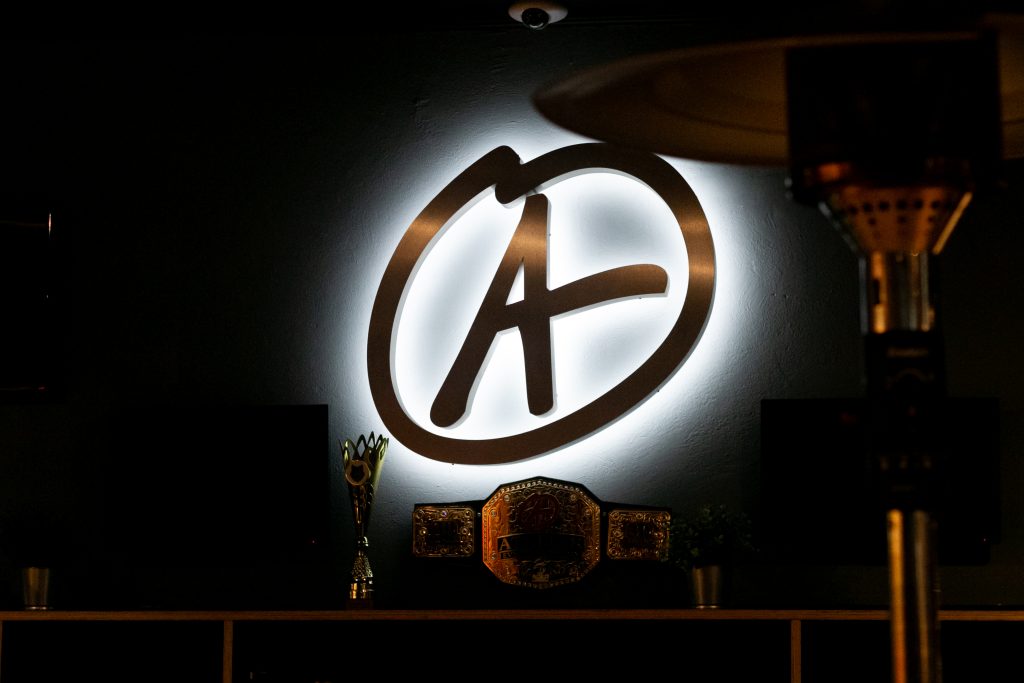
High school eventually came to an end and each went their separate ways. Laurent turned to entrepreneurship and founded an IT company that is still active today. Petz moved to Brussels to study journalism. The years passed, but the two friends continued to attend concerts together in Paris, Cologne, or Brussels. Until 1995. Stuck in traffic, Laurent spotted a hall for rent in rue de Hollerich. “I went to see it, I called a few friends, including Petz, and I thought: what if we threw parties again? What if we brought the Party Team back to life?” That’s how den Atelier was born. “The name was easy to find: it used to be a car repair garage, a mechanical workshop. I remember sketching the logo on a beer coaster,” Laurent says. “We had no experience, very little money. We did everything ourselves.” The venue officially opened on October 23, 1995.
First headliner
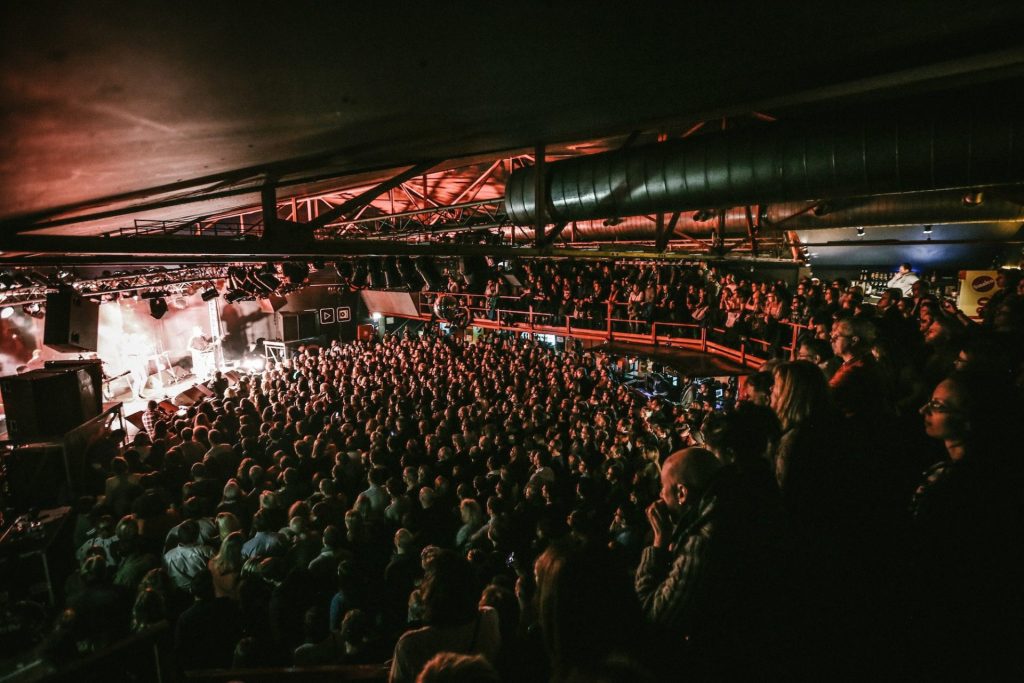
At first, the space mainly hosted parties stretching into the early hours, much to the neighbours’ dismay. Gradually, concerts took over. “We were tired of driving miles to see our favourite bands. There weren’t any other venues here at the time, so we started booking shows ourselves,” says Petz, who became the venue’s official booker. The first major headliner to say yes: Jimmy Somerville. “The Luxemburger Wort reported the news using the conditional tense. That said a lot about our credibility… but it really was a bit crazy. We were overexcited. I don’t think we slept for days. But it was amazing.”
Word travelled
In the live industry, reputation travels faster than any marketing campaign: good shows lead to more good shows. The small Luxembourg venue quickly built a name for itself. “Agents got good feedback from their artists, so they sent more our way. And we also benefited from the interest coming from England, where there’s a real culture of live music in small clubs,” explains Petz. The venue gradually established itself as a reliable stop on international touring circuits, eventually taking the duo all the way to Los Angeles.
“We found ourselves in front of a huge building to meet a major figure in the American music industry. It was just like in the movies. We were the two little Luxembourgers, introducing ourselves at one, two, three reception desks, until we heard a booming voice shout, ‘Let them in!’ We walk in… and there’s this small bling-bling guy in an office covered in gold records,” Laurent laughs.
Structuring to endure
For years, stars and legendary bands followed one another on the Hollerich stage. “Honestly, in 1995, when I called my friends to rent the place, I thought it would last six months. I never imagined it would still be going thirty years later,” Laurent admits. “No one imagined it. We always moved forward like that, working alongside our day jobs, driven by passion and pleasure,” adds Petz, who is today a well-known journalist in the country. “It was crazy. We learned everything on the job, and took it day by day. We didn’t sleep before concerts, we made mistakes, but we kept going, and we always did it with love and sincerity,” Laurent continues.
“We didn’t sleep before concerts, we made mistakes, but we kept going, and we always did it with love and sincerity”
A wake-up call
In 2006, den Atelier launched Rock-A-Field, a festival that would run for ten years in Roeser. “It was amazing, but it was never profitable. Everything we earned during the year, we lost at Rock-A-Field.” The festival’s relative failure served as a wake-up call: passion alone was no longer enough when scale and financial risks increased. “The wake-up moment is when you reach your own limits. When you realise you can’t keep doing everything with friends in their spare time.” Michel Welter, who joined in 2008, took charge of structuring the business, particularly the production side, now grouped under A-Promotions. Den Atelier moved from being a passionate adventure to a structured company, without losing its independent DNA. Today, the team counts 11 permanent employees with the team rising to 400 for bigger productions like the summer Open Air festival at Luxexpo. The team organises 132 and 149 concerts per year (2022–2025), selling more than 200,000 tickets annually, half of them abroad.
An undiminished sense of wonder
In 2025, den Atelier was chosen to produce the “Trounwiessel”, a show organised in Luxembourg-Limpertsberg to mark the coronation of Luxembourg’s new Grand Duke Guillaume. The national event was funded by the State to the tune of approximately €7 million, of which €4 million covered the portion produced by den Atelier, a private structure. “With my team, we decided to break the codes, to revisit the national anthem even though it’s normally forbidden. In the end, those responsible for enforcing the rules congratulated us by email the very night after the show. We chose to put only Luxembourgish artists on stage because it was probably the only opportunity to bring them all together like that, and we involved the residents. It was incredible. We even dared to display ‘Thank you Stéphanie and Guillaume’ with a heart emoji on stage, not very protocol-friendly, but it worked. I think we did things right,” Laurent says.
With an undiminished sense of wonder in their eyes and their words, a touch of pride and still a great deal of disbelief at how far they’ve come, the two partners now watch the industry evolve, as giants like Live Nation buy up venues one after another. “And yes, maybe, one day someone will approach us,” they say. But for now, their focus lies elsewhere: preparations are already underway for Open Air 2026.
This article was published in the 9th edition of Forbes Luxembourg.
Read more articles:
Europe Must Win The Space Race
