
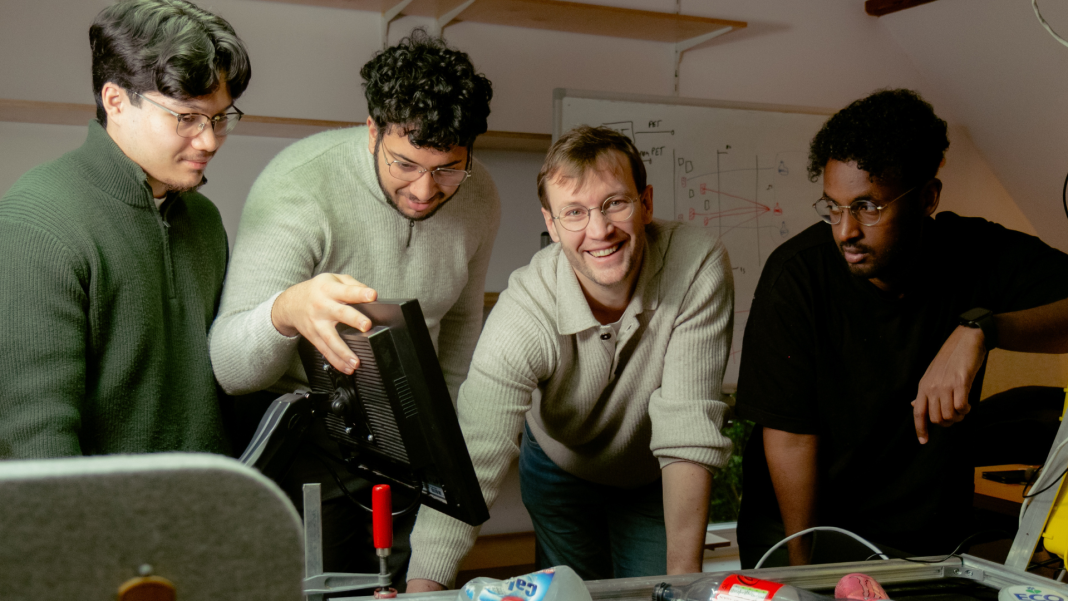
To better control the quality of waste sorting and improve recycling rates, Luxembourg startup CRAB is developing an artificial intelligence analysis solution designed to be easy to use, mobile and affordable.
With a camera coupled with artificial intelligence and a solid database, the Luxembourg start-up CRAB, short for Circular Resource Analysis Bridge, aims to revolutionise waste recovery.
The importance of the challenge is obvious. Across all categories, the total amount of waste generated in the EU in a single year represents around five tonnes per inhabitant. Currently, 40 percent is recycled, and more than 60 percent is recovered, notably through incineration with energy recovery.
The effectiveness of recycling nevertheless depends on one essential factor: the quality of sorting upstream. Is waste really properly separated? Is it clean enough to be recycled? It is this question that the three founders of CRAB, Jeff Mangers, CEO, Alexej Simeth, CFO, and Atal Kumar, CTO, decided to address by creating their company in August 2024, after years of study at the University of Luxembourg on these issues.
Manual waste management
In practice, traditional waste sorting control, carried out manually, proves to be a long, costly and tedious operation. A concrete example: in Luxembourg, the government regularly carries out residual waste sorting audits, aimed at identifying what proportion of recyclable materials still ends up in black bins destined for incineration. The process is laborious. For two months, around ten people manually open waste bags to count aluminium cans, PET bottles and other recoverable materials. This method makes it possible to check around 200 kilos of waste over the course of five hours. And, as Jeff Mangers points out, “in the end, the quantity to be analysed and therefore the data obtained remain very limited”.
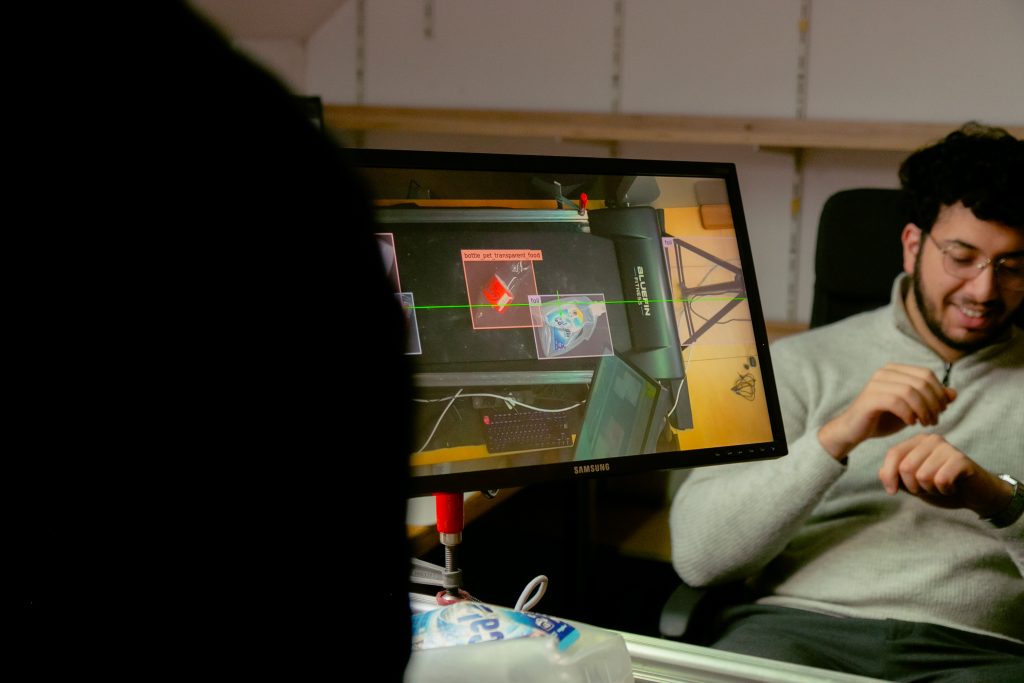
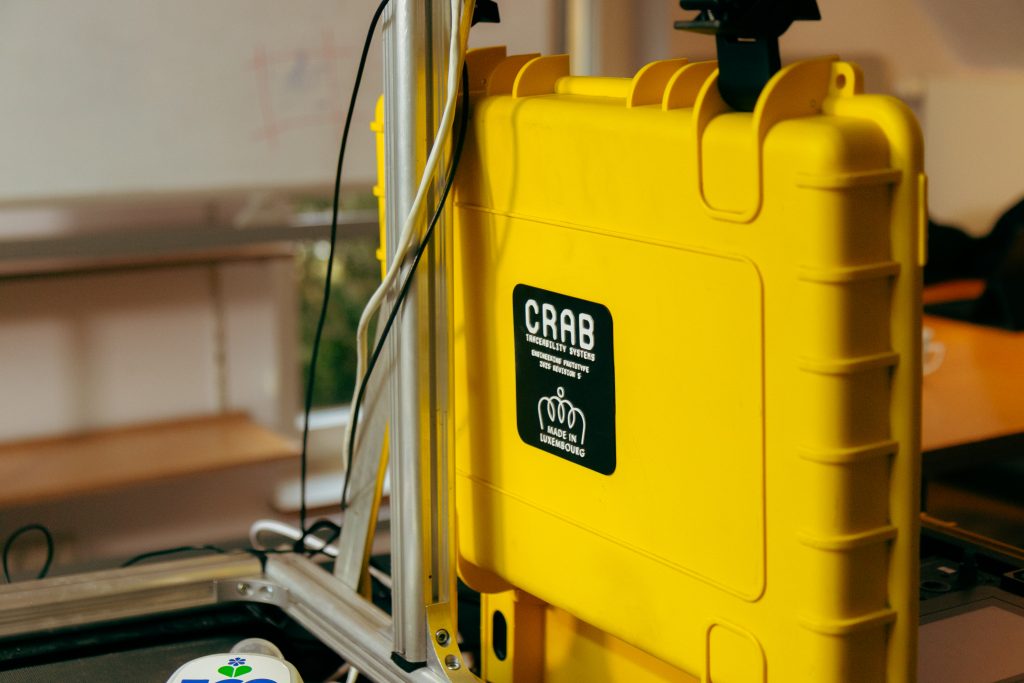
CRAB’s solution, called “Quality control in a box”, is based on a simple setup: two cameras, a casing and a computer. This trio, equipped with a visual recognition system, analyses in real time the composition of waste streams circulating, for example, on the conveyor belts of a sorting centre. During a test, CRAB managed to analyse 250 kilos of waste in 20 minutes, with reliability above 90 percent, a task that would have required five to six hours of manual work involving five people using the traditional method. The productivity gain is obvious.
The effectiveness of the system nevertheless varies greatly depending on the materials analysed. PET bottles or aluminium cans are generally easy to identify, unlike biodegradable waste, where the difference between a banana skin and potato peelings is significant, or construction waste, which is often made up of highly heterogeneous materials. Packaging poses an additional challenge. “It is often very difficult to precisely identify the material from a simple image”, explains Jeff Mangers. “For example, it is almost impossible to distinguish a polyethylene plastic film from a polypropylene film.”
Sorting by machines
To overcome the model’s difficulty in sorting the most complex elements, there is a solution: training the model to improve its detection capabilities. “If a person is able to distinguish different types of waste with their eyes, the machine can do so as well”, assures Jeff Mangers. To achieve this, the model needs to be fed with very large amounts of data, namely multiple images of materials that will eventually enable it to clearly differentiate between them. This is why building a solid database is crucial, one that will grow with each deployment and be diversified as much as possible. “We have residual waste sorting in Luxembourg, as well as a lot of packaging that we are working on with our partner HEIN Déchets,” notes Jeff Mangers. “Now we also have construction and deconstruction. And I hope we will also obtain projects in electronics.”
“A sorting centre can have around fifty different belts”
CRAB is certainly not the first player to offer an automated visual recognition system for waste sorting. Other major operators are already present on the market. There is, however, a difference: most offer fixed installations. “A sorting centre can have around fifty different belts,” illustrates Jeff Mangers, each one dedicated to a category of material, such as PET bottles or packaging. “So to obtain analysis on all the belts, you need around fifty machines. Not to mention that a shutdown of the facility is required during the installation of each machine. All of this costs a fortune.”
New offers
The distinguishing feature of CRAB’s solution is that it is mobile, highly flexible and therefore less expensive. “I come, I install it in less than five minutes, I collect my data, I uninstall it and I move on to the next belt,” explains Jeff Mangers. “It’s simple, there’s no need to plan six months in advance. The idea is really plug and play.” Operators can therefore deploy the device when and where they need it, and even purchase it to manage it independently according to their specific requirements.
Still in the testing phase, CRAB has so far only billed its clients for the service, meaning the analysed data, during 2025, but not yet for the hardware, namely the camera system. This should change in 2026, with two offers under consideration: either the purchase of the camera with a recurring payment for the dashboard and software updates, or a leasing model covering hardware and software for a defined period.
With six full-time employees, CRAB already has a diversified customer base in Luxembourg and beyond, including Italy and the Netherlands. Potential clients mainly include sorting centres, but also public administrations, municipalities and audit firms responsible for regulatory controls.
CRAB also aims to work with brand owners, the industrial giants that manufacture their own containers, such as Coca-Cola and its PET bottles. These companies must verify that their products are genuinely recyclable. “You have to conduct industrial tests and have data to prove that a bottle is recyclable,” explains Mangers. “What is interesting for us is that we are in the sorting centre and therefore have access to the information.”
EU Circular Economy Act
These ambitions align with a regulatory context that is evolving in CRAB’s favour. The EU is progressively tightening standards, with the 2018 revision of extended producer responsibility, the forthcoming Circular Economy Act, and above all the recent regulation on packaging and packaging waste. All these measures encourage the design of products that are easy to sort and recycle.
“There is value in waste: every PET bottle sorted means more money”
Beyond regulatory requirements, ensuring effective sorting simply represents an economic gain for companies. “There is value in waste: every PET bottle sorted means more money,” reminds Jeff Mangers. “It’s economically straightforward.” This logic should be enough to motivate companies in the sector to adopt more effective and accessible sorting control solutions.
This article was published in the 9th edition of Forbes Luxembourg.
Read more articles:
Luxembourg’s Tokenised Funds Move Beyond Experimentation
