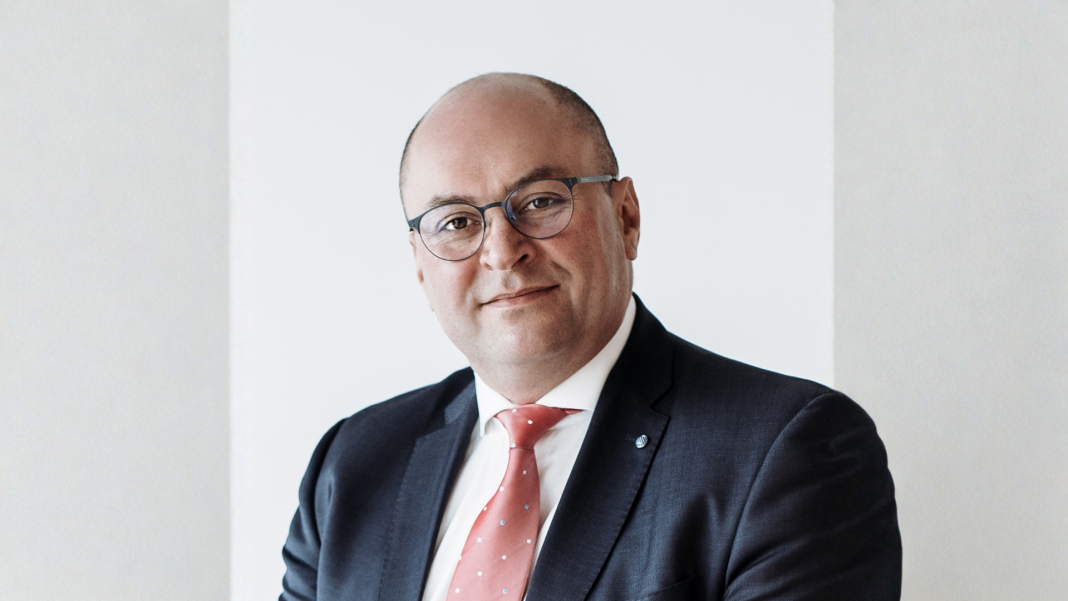
When Konstantin Notman joined OCSiAl in 2012, the company was little more than an audacious idea. A decade later the Luxembourg headquartered scale up has become the world’s dominant producer of single wall carbon nanotubes, or graphene nanotubes, supplying nearly all major battery makers and a growing range of advanced materials industries.
Now OCSiAl is preparing its most ambitious step yet, the construction of a flagship manufacturing site in Differdange that will turn the Grand Duchy into a global centre for next generation materials.
Notman’s own journey mirrors the company’s appetite for reinvention. Born in Siberia, he built a career in complex industrial turnarounds across Europe and Central Asia before accepting what he describes as a “crazy” challenge joining a team trying to commercialise a material that seemed closer to science fiction than industry. Graphene nanotubes are one atom thick sheets of carbon rolled into minuscule tubes with extraordinary mechanical, thermal and electrical properties. Used as additives, they can transform batteries, composites, tyres, coatings, sensors and many other materials.
“Today everyone knows OCSiAl, but in 2012 it was from scratch,” he recalls. “It was difficult to imagine that one material could improve half the materials around us.” Yet a decade of validation, certification and scaling has brought the company to a point where demand far outstrips supply. OCSiAl’s revenue doubled in 2024 compared with 2023. The company, Notman says, “could sell more than 200 million if several synthesis units were already operational.”
This supply gap underpins the decision to invest heavily in new production capacity. The Differdange plant will produce up to 700 tonnes per year, doubling production capacity of OCSiAl’s Serbian facility when it is fully built out. And could generate around 1 billion dollars in annual revenue. The first phase is expected to be operational in 2028 and full capacity a year later. The site will employ more than 300 people, half of them chemical engineers and process specialists.
Choosing Luxembourg for such a capital intensive project has raised eyebrows abroad, but Notman is unequivocal. “Luxembourg is attractive for people and talent, it offers guaranteed green energy at competitive industrial prices, and it is our centre of gravity.” The company already employs more than 50 people in the country, hosts one of its R and D centres here and concentrates its global management in Belval.
The challenges ahead are substantial. OCSiAl expects its global workforce to reach 1000 within two and a half years and is building internal training systems to create mentors who can transmit knowledge across future sites. Regulation is another constant hurdle, with millions already spent to secure approvals in the EU, US, Korea and elsewhere.
Yet Notman’s ambition extends far beyond current markets. The company’s labs in Luxembourg, Shanghai and Serbia are developing flexible conductive materials for medical sensors, artificial leather for automotive interiors and other applications that “feel like the future of materials”. And the long term vision is clear. “In fifteen years OCSiAl will be a public company with multibillion revenue,” he says. “We will be in every automotive battery, in robotics, in advanced tyres, in composites. What we are doing is important for people’s lives.”
For Luxembourg, OCSiAl’s expansion signals something equally significant. A country known for finance may soon become indispensable to the global battery and materials supply chain.
This piece includes AI-generated text, reviewed and edited by Jess Bauldry
Read more articles:
Luxembourg: A Strategic Hub For Corporate Banking In Europe
Norman K. Bets On Independent Wealth Management Consolidation By Establishing Luxembourg Office
Talk B17 x Forbes: Entrepreneur… and After? Life After The Exit