
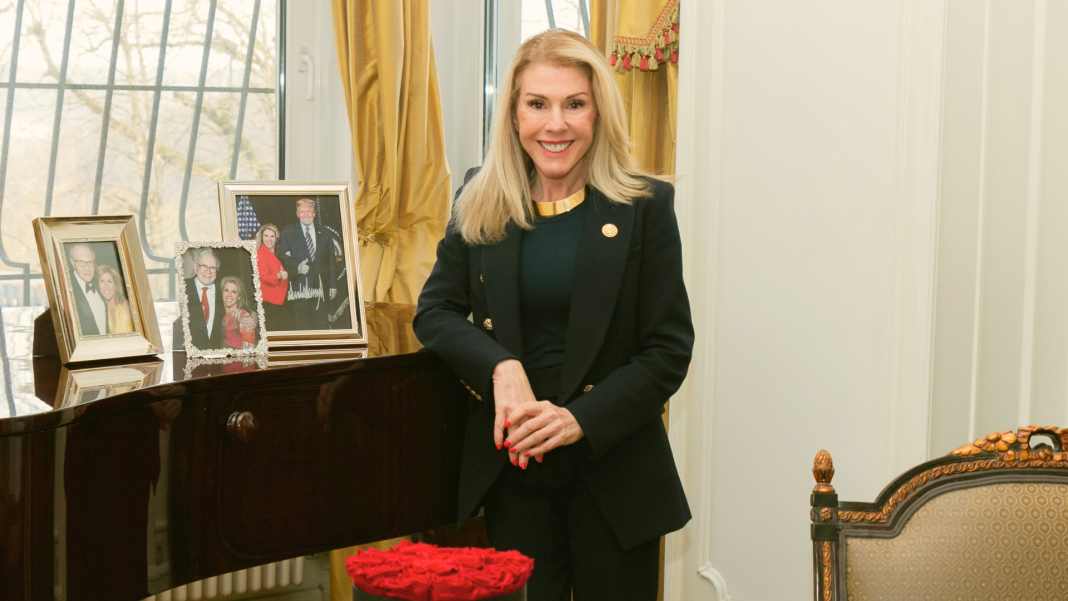
Nearly six months into her tenure, US Ambassador to Luxembourg Stacey Feinberg speaks with Forbes Luxembourg on transatlantic ties, Luxembourg’s tech promise, and what convinces angel investors.
When US Ambassador to Luxembourg Stacey Feinberg talks about empowering women entrepreneurs and backing their businesses, her face lights up. “I look at it this way: I want women to be funders and founders. We need both,” she says. “And the more women funders there are, like myself, the better it is for the founders because women invest in women more than men do.”
Long before serving as the 25th American ambassador to Luxembourg, she began her career at her father’s law firm in Boston, Massachusetts. It was there, at Bob Woolf Associates, a firm working with sports and entertainment clients such as Larry Bird, Larry King, and New Kids on the Block, that she developed the firm’s literary division. Being at his side, she says, not only inspired her and taught her the importance of relationships, but it also formed values like integrity, trustworthiness and having a long-term focus. “I think that has really served me well in every aspect of life because people know if I say something, I will do it,” she adds.
For her, this doesn’t translate into mere financials when she considers backing a company. Instead, it means, “I’ll be a strategic advisor, not just an investor. I’ll pick up the phone. I’ll help you. And I learned all this from my dad.”
“Dolphin tank” approach
As an angel investor with 24 companies in her profile, Ambassador Feinberg was moved to act after she found out that “only 4% of VC [venture capital] money was going to women, and I said, ‘We have to level the playing field.’” When meeting with these entrepreneurs, she would invite them into the “broad room”, a playful take on the boardroom, and a joke which may have helped create the relaxed atmosphere she was aiming for. She also preferred the term “dolphin tank”: unlike the aggressive Shark Tank pitches on television, she opted for collaborative sessions to help entrepreneurs scale their ideas.
When deciding which companies to invest in, she looks for the “have-to-have” solutions rather than “nice-to-have” ones. One standout in her portfolio is Cooler Heads Care, a company founded by Kate Dilligan, a Stanford-educated entrepreneur and cancer survivor. The company designed the Amma™ Scalp Cooling System, which it describes as a product that “cools the scalp before, during, and after chemotherapy, helping reduce the amount of chemotherapy that reaches the hair follicles so patients can preserve their hair.”
As Ambassador Feinberg recalls during our interview in January, she met Dilligan at a conference, commented on her “beautiful red hair”, and Dilligan drew her concept on the back of a napkin. Feinberg asked whether Dilligan had a minimum viable product yet and then how much it would cost to develop one, and she was sold. The ambassador says that today, the company is present in 165 infusion centres, and she has received letters and photos of “grateful patients who save their dignity, sometimes save their secret, save their jobs,” all because of a device that is “less than the cost of a wig.”
It’s not just about a deck
Having been a frequent judge at venture capital pitching competitions, Ambassador Feinberg says she can “read decks, in the dark. I’ve got it down.” The first thing she likes to look at is the size of the problem and total addressable market. She learns about the solution, she focuses on the team. “You can have a great solution, but if you don’t have the team… it isn’t going to happen. You could also have a great team, but the problem isn’t big enough… so you have to have the combination.”
When it comes to a pitch, “I want you to make me feel, I want you to tell me a story. I want to know how you came upon this problem, and how you came upon the solution.”
In some cases, she has to help the entrepreneur pivot. She recalls meeting a woman who was “literally a rocket scientist” and a “genius”, but Feinberg realised this was not the right person to represent the idea, the business. And so she suggested to her that she “find somebody who is very charismatic, that you can bring in as part of the company, because when you do go and give your pitches, you’re going to need that kind of person to work with you. But be next to them to answer the technical questions.”
Transatlantic business relations
Ambassador Feinberg sees Luxembourg as the European country most closely aligned with the US, not just due to the countries’ shared history through significant Luxembourg emigration to the US (as of the mid-1800s) or their relationship in two World Wars, but also in terms of “shared values, stable economy [and] democracy.”
She sees Luxembourg as becoming more attractive to the UK in the financial sector, as well as being “a perfect place for space satellites, data centres, all these technologies of the future, utilising US technology… it’s going to be a great partnership.” From her perspective, she sees the potential of Luxembourg’s dual-use technology. “I think that they want to invest in things that they already have a headstart on, like satellites, telecommunications, space technology, things that can then be utilised by the US and their NATO allies that will fulfil their financial obligation while also creating things for the whole world to use that will make the world safer. And, by the way, they’ll make money on it as well.”
One example she cites is SES, “the crown jewel of Luxembourg”, with its “fantastic” CEO, Adel Al-Saleh. The company recently announced vertically integrating the company and producing satellites in Luxembourg. “There’s so many things that they can do that will make the world so much safer, and financed from Luxembourg.”
“I intend to bring as much U.S. technology as I can bring here. I think that Luxembourg is ready for a pivot”
Among Ambassador Feinberg’s other priorities includes bringing new business to Luxembourg. “I intend to bring as much U.S. technology as I can bring here. I think that Luxembourg is ready for a pivot.” She’s also keen to engage with local students. “I want them to ask me questions about business and starting, running, or funding a company,” she says. “At least I could be a friendly face to represent the US and provide some context on [it].” She adds that these students aren’t too young to start companies, so she hopes to inspire the new generation with the entrepreneurial spirit.
This article was published in the 9th edition of Forbes Luxembourg.
Read more articles:
How Rising Populism Is Affecting Markets And Portfolios
Talk B17 x Forbes With Stacey Feinberg, US Ambassador To Luxembourg