
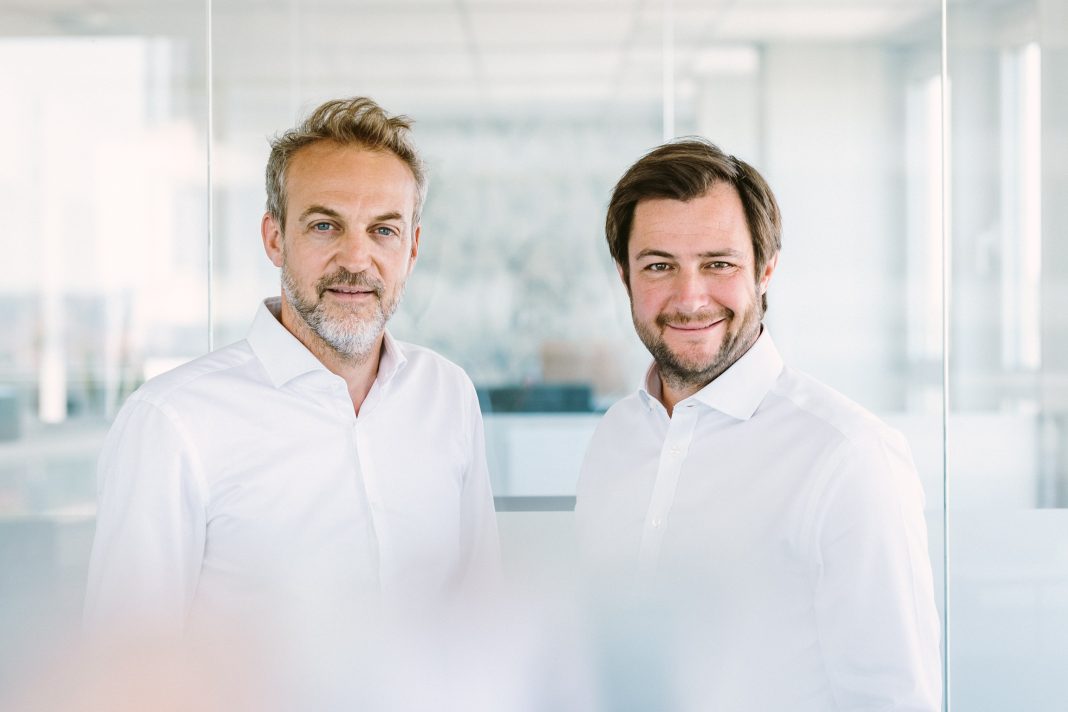
Nicolas Crochet and Patrick Somerhausen, co-founders of Funds For Good, have built an asset management firm that donates half of its profits to support entrepreneurs excluded from traditional financing and explain why the model is not just idealistic but built to last.
A Decision Born From Volunteering
Funds For Good began with two friends questioning the meaning of their early careers, one in private banking, the other in consumer marketing. A volunteering experience supporting asylum seekers in Belgium proved decisive: “That amazing experience… decided to go further, and give a decisive new direction to our professional career by setting up a company where the ‘for profit’ activity would permit us to finance a social project where we could both take part.”
Founded after the duo first sketched a business plan in 2008 and launched in 2011, the company rests on a simple premise. As the founders explain: “2 reasons definitely convinced us to start Funds For Good: the need to bring meaning to our professional lives, and the fact that company founders are free to allocate the profits of their activity. This is why we decided to donate half of them.”
“The aim is to directly finance very high impact generating companies and activities.”
The Snowball Mechanism
The firm operates two arms: an asset management business and a non-profit offering “loans of honour”, interest-free, guarantee-free loans paired with coaching for entrepreneurs who lack the collateral for traditional bank financing.
The founders describe the funding model in simple terms: “every year, it received 50% of the profits of the commercial activity. At the same time, several of the Loans of Honour granted in the earlier years are reimbursed, bringing new financing to new entrepreneurs. This mechanism generates new loans every year, which are as many new personal and beautiful stories to discover.” This, they say, “permits investors to consider their investments as tools to generate a benefit on both their side, and for society.”
Despite the social mission, performance remains non-negotiable. As the founders put it: “in a very crowded market when it comes to the distribution of investment funds, Funds For Good funds need to offer competitive returns. We have to make sure our managers remain in the top-league, that the strategies are fit to the economic environment and deliver performance.” The firm has also launched ImpaktEU, a non-listed impact fund where “the aim is to directly finance very high impact generating companies and activities,” and which counts only “patient investors” ahead of its final close at the end of 2026.
An Emerging Ecosystem
On systemic change, the founders see real momentum building around micro-finance. They note “a growing number of financial actors willing to partner with us and other micro-financing entities, that are serving the needs of those starting up entrepreneurs that have strong and convincing projects, but lack some financial resources to get a regular bank loan.” More broadly, they describe “the emergence of a very strong ecosystem where all initiatives linked to entrepreneurship… are getting together and communicating in order to facilitate the life of starting entrepreneurs and their path to success.”
“Netween now and 2035, 3500 billion Euro of wealth transfer will land into the hands of younger inheriting generations.”
Eighteen Years of Co-Leadership
Running the company as co-CEOs has meant navigating both euphoric growth and difficult years. The founders describe it candidly: “from the conviction we would very quickly raise assets when we started in 2011, to the desperation of crossing the desert during the first years, the exhilaration of our rapid growth from 2014 until after covid, to the rapid transformation of the economic landscape since then.”
Roles eventually divided naturally, with “Nicolas logically focused on sales and development of investment funds, where his professional experience lied, and Patrick developed the impact side as a whole.” Former Delhaize CEO Pierre-Olivier Beckers chairs the board, with his wife Karine on the credit committee, a support the founders rely on, noting that “when conflicts arise, or ideally before they arise, we never hesitate, as our entrepreneurs, to ask for some coaching.”
Looking to 2035
On the future of responsible finance, amid scrutiny over greenwashing, the founders remain confident: “this test period has revealed that investment funds demonstrating transparent and tangible impact, and capable of delivering additionality, are in growing demand.” They cite a JP Morgan study showing that “between now and 2035, 3500 billion Euro of wealth transfer will land into the hands of younger inheriting generations,” over 95% of whom show “great interest in sustainability in their future investments.”
Their ambition: “Funds For Good achieving its ambitious development plans in the 10 years to come, with a presence in several new countries, with a larger fund investment offering… clearly supported by a wave of new investors with whom we share common values.”
Read more articles:
Voices International: The Soundtrack Of Luxembourg’s Melting Pot
