
Paris-based Mistral wanted to develop a top-tier AI model to rival OpenAI and Anthropic. That didn’t work out. But it turns out lots of folks don’t care if the AI is bleeding edge – as long as it wasn’t made in America or China.
When Arthur Mensch, the cofounder and CEO of Mistral, France’s leading AI company, takes the stage at the AI Action Summit in the center of New Delhi, India, in February, he draws only a small crowd. Nearly everyone would rather listen to sermons from OpenAI’s Sam Altman or Anthropic’s Dario Amodei, preaching the promises and perils of superintelligent AIs.
But the small cadre of executives and researchers in Mensch’s audience catch a very different message: The rest of the world should control its own AI destiny, not Silicon Valley. And Mensch can help them do it. “AI should be a tool for empowerment, not dominance,” he proclaims.
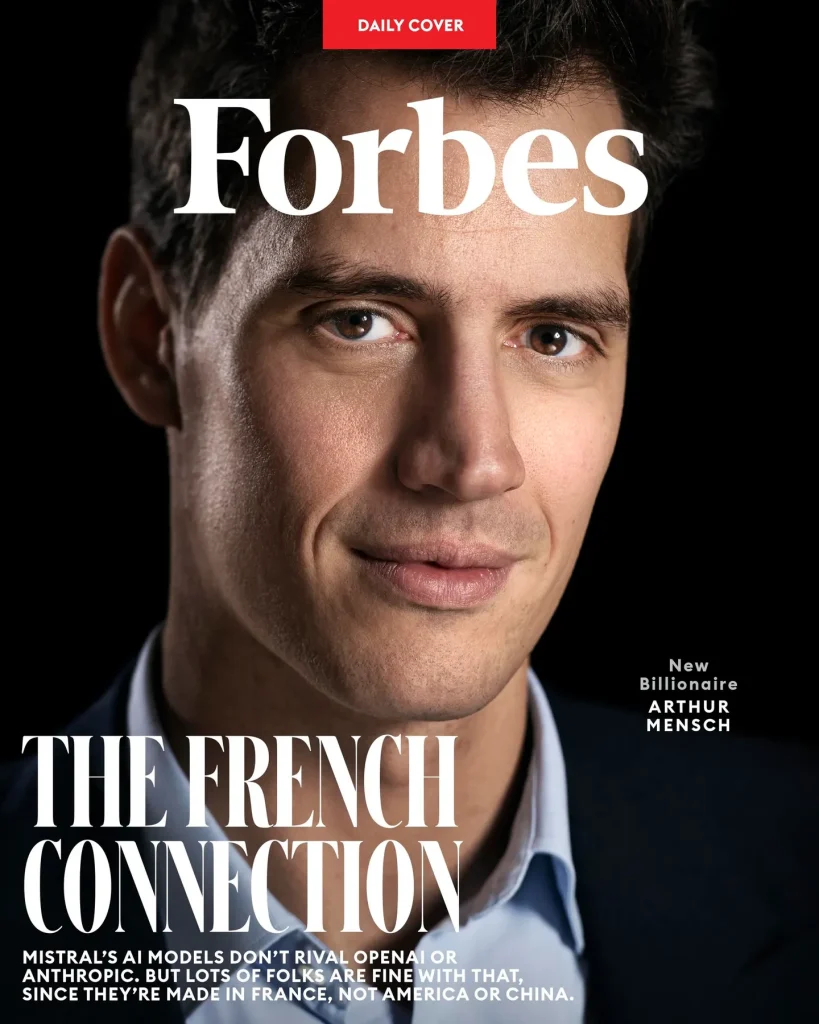
Mensch’s vision for Mistral, and AI itself, can be summed up in one word: independence. Unlike its black-box Silicon Valley rivals, most of Mistral’s AI models are what techies call “open weight.” In this sort of open-source model, customers are free to get under the hood, customize the AI using their own data or download it for free to run offline (or from a laptop).
The message resonates. Old-school execs are spooked by the world-consuming rhetoric of OpenAI and Anthropic and the emerging threat of Chinese AI companies. Mensch’s talk of control and sovereignty is soothing, as is his pitch that Mistral will deploy engineers to set up and run the tech for them. Your data doesn’t even need to leave the office, let alone the country.
“We are really the only company that allows [building] core business automation and products on top of an open stack, and that is something that is valuable everywhere in the world,” says Mensch, 33, from Mistral’s offices in the trendy 10th arrondissement of Paris, as kids play soccer in the courtyard out back.
European firms are especially interested in Mistral. At a time when a German state government is scrapping Microsoft Office for official business, and France is rolling out its own alternative to Zoom for video calls, there’s opportunity for Mensch to swoop in with the promise of secure and proudly European-built AI.
Donald Trump is another driver of business. The president’s trade war, threats to annex Greenland and promises to shield American tech companies from regulation have sparked concerns about reliance on anything American—from software to data centers and now AI. “The independence we provide to our customers is critical for our product,” Mensch says.
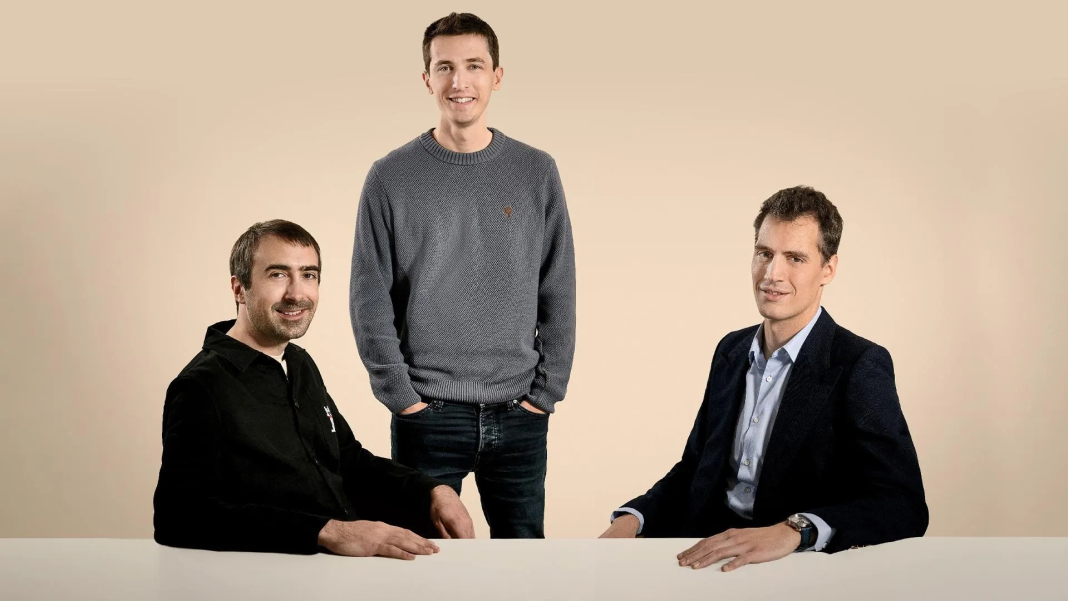
Mistral needs all the extra edge it can get. Mensch and cofounders Guillaume Lample and Timothée Lacroix are some of France’s finest technical talent, hailing from the Parisian outposts of top American AI labs. But Mistral has slipped ever further behind in leaderboards ranking AI performance. It’s so bad that Mistral’s best model would lose in a face-off against a version of Anthropic’s Claude that was released nine months earlier, per one popular benchmark. Worse, it’s also bested by a new crop of open-weight models from Chinese startup DeepSeek and tech giant Alibaba.
That’s not surprising. Mistral’s American rivals are loaded with cash. They are willing to spend more per year than the $3.1 billion Mistral has raised to date (including from French institutions such as BNP Paribas and Bpifrance). Its Chinese competitors claim they can train AI models more cheaply, but they are widely suspected of “distilling” secrets from American AI giants by prompting Claude and ChatGPT millions of times to train their models.
In a space obsessed with performance, that should make Mistral an also-ran. But Mensch bets that a smaller, cheaper model made in Europe is better suited for governments and global companies than an American closed-source LLM with far more horsepower. Plus, it’s too risky for serious Western companies to depend on Chinese models, says Mistral investor Jeannette zu Fürstenberg of venture fund General Catalyst. The strategy has worked to the tune of $200 million in revenue in 2025. And Mensch says Mistral is on track to start making around $80 million monthly by December, although due to high compute and data costs the company isn’t yet profitable.
“The question to ask is, ‘Is Mistral at the top of the independence leaderboard?’ ” says Anjney Midha, who led Andreessen Horowitz’s investment in a $415 million round for Mistral in 2023 and now runs his own AI investment firm, AMP.
Mistral has deals with London-based HSBC (Europe’s second largest bank, with over $3 trillion in assets), British grocery store giant Tesco (2025 revenue: $70 billion) and CMA, the world’s third-largest shipping company by capacity ($54 billion in 2025 sales). President Emmanuel Macron, who has called Mistral an example of “French genius,” has lined up contracts to plug its AI into government agencies ranging from its military to its bureau for job seekers. Mistral is also working with Singapore’s military and the governments of Greece and Luxembourg. If Mistral “doesn’t become a $100 billion company, it’s only because they screwed it up,” zu Fürstenberg says.
Silicon Valley types might sniff that the startup is now little more than a “system integrator,” with a chunk of its revenue stemming from Palantir-style consulting deals rather than cutting-edge AI. But so what? The strategy is working. Mistral now has the support of ASML, Europe’s most valuable tech company ($560 billion market cap), which makes the equipment nearly the entire tech world relies on to etch circuits into silicon chips using ultraviolet light. The Dutch-listed firm led a $2 billion round into Mistral in September and signed a deal to use Mistral’s AI in its products and research. That round valued the startup at $14 billion, making its three cofounders new billionaires, each with a 13% stake worth $1.8 billion.
To keep growing, Mistral just needs to fully exploit its niche as a safe haven from AI’s superpowers in the U.S. and China. Of course, it can’t give up on improving its models altogether. At some point OpenAI and Anthropic’s models might get so good that some large customers trade safety and sovereignty for raw performance.
Mensch was born in a Paris suburb to a physics teacher mother and a father who runs a small computer server company. A third-gen computer scientist (his grandfather worked on health data systems), he crossed paths with Lample, 35, at Paris’ elite École Polytechnique. In 2016, while studying for a Ph.D. in AI at Pierre and Marie Curie University (now part of the Sorbonne), Lample landed a job at Meta’s AI research arm, where he worked with Lacroix, 34. After getting a Ph.D. from the University of Paris-Saclay, Mensch did two years of postdoctoral research before landing at Google’s Paris office, working on DeepMind, in 2020.
There, Mensch worked on a groundbreaking paper that showed large language models could be built much less expensively than previously thought. Lacroix and Lample used those ideas to help build low-cost open-weight models at Meta’s Fundamental AI Research lab. When the project, called Llama, dropped in February 2023, it was an instant hit: small, cheap and powerful, perfect for academic researchers and startups on tight budgets.
The three quit their jobs soon after. “We had already started to think about what we could be doing here in France,” Mensch remembers.
For decades, through the dot-com boom, the explosion of social media and the emergence of the cloud, Europe has been stuck in tech’s slow lane. Mistral’s cofounders were convinced that the continent needed its own AI models, and that its socialistic governments and industrial giants would pay for them. They named the company after a powerful wind that batters the Mediterranean in the winter. Silicon Valley VC firm Lightspeed led a $115 million seed round, at the time Europe’s largest, in 2023.
Mistral’s first models, released later that year, also caused a splash. Mensch had delivered on his promise that great AI could be built and run for a fraction of the cost of OpenAI’s ChatGPT. The company later launched its own ChatGPT-style app—dubbed Le Chat, naturellement—that scored 1 million downloads within its first seven weeks, the majority in France, per Appfigures.
But Mistral was soon utterly outspent and outpaced. OpenAI and Anthropic have raised more than $200 billion over the last two years. They are valued at $840 billion and $380 billion, respectively. Last year, OpenAI brought in around $13 billion in revenue, while Anthropic had some $4.5 billion. According to a Menlo Ventures survey of 500 American enterprise business executives, Anthropic has a 40% market share, OpenAI has 27% and Mistral has 2%. (It’s worth noting that Menlo Ventures is one of Anthropic’s biggest backers.)
By 2024 it looked like Mistral was running out of wind. Critics said it was losing ground, and its revenue that year was reportedly well short of $50 million. Mensch concedes that the team had “learned on the job” after working at research labs with little focus on commercialization. But revenue steadily ramped up as slow-to-negotiate but sizable deals started to land.
“If we’re successful, Europe will be successful.”