
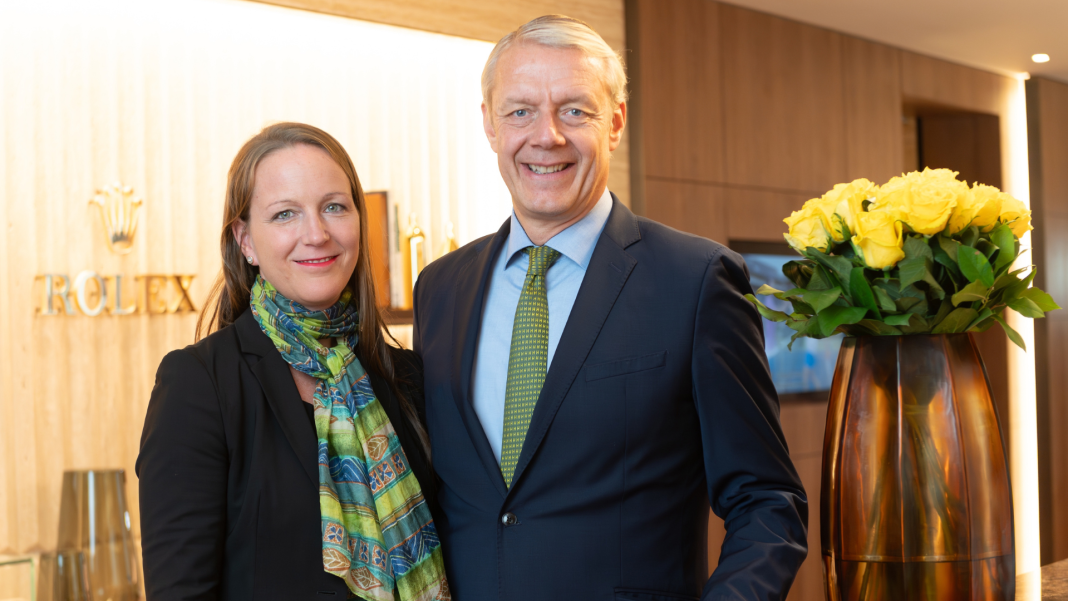
In a world obsessed with speed and disruption, Robert Goeres has built a luxury business around calm. Inside his Rolex boutique in Luxembourg, time slows, and that is precisely the point.
The door of the Rolex boutique on Avenue de la Porte Neuve in Luxembourg City glides open into a space that feels less like a watch store than a modern museum.
Books sit neatly on shelves. Flowers peer from elegant vases. And always in sight is the back wall: formed from separate blocks of Alpine Verde marble cut in fluted bezels, pieced together to form a seamless seascape.
“Those are the waves and the foam on top of the waves. It’s a rough sea,” boutique operator Robert Goeres says, waving a hand in front of the scene. The wall is a feature of the newly renovated shop where nothing is accidental. Rolex motifs are discretely embedded everywhere in the newly renovated interior. A Roman ten X in the legs of a table, a honeycomb on a cushion mirroring the watch dial. More than a decoration, for the entrepreneur these motifs offer assurance.
In addition to the Rolex boutique, Goeres runs luxury watch retail business Goeres Horlogerie, a business begun by his father, Raymond Goeres, in 1956. He also operates boutiques dedicated for exclusive brands, and built an authorised Rolex watch service workshop. As president of the Luxembourg Retail Federation and elected member of the Luxembourg Chamber of Commerce, he is active in Luxembourg’s entrepreneurial ecosystem.
At no point does he labour his successes. On the contrary, his first sentence is to explain his dyslexia. “I cannot read or write but I can speak,” he says. This difficulty forced him from a young age to talk through his ideas. The result: the entrepreneur speaks in long, looping thoughts, but thinks with surgical clarity. He craves calm and has little patience for disruption masquerading as progress.
This is why he has designed a space which favours states of reflection and intimacy over novelty. Where leaving with a feeling is more important than leaving with a watch.
“Watches are about craftsmanship and here we have craftsmanship,” he says during a tour of the boutique. To Goeres craftsmanship is more than a mere buzzword. At 15, he studied horlogerie in Geneva, Switzerland. The gruelling 43-hour weeks of maths, trigonometry and mechanics in Geneva opened up a new world. English, he says, was the last language he learned. “I’m a doer,” he says, which is why he took himself to the south of England, to master the language by speaking it. He completed a programme at the British Institute of Marketing and has fond memories of his time there.
It was in the 1990s that Goeres joined the family business and in 2007 he relocated the boutique to the city centre. The newly renovated Rolex boutique initially opened in 2019 as a multi brand point of sale, shortly before the 2020 pandemic. It was a difficult time for all retailers but more important than the forced closure through lockdown, the pandemic accelerated changes in consumer behaviour: digitalisation. Paper catalogues were no longer necessary. Even the need for a watch itself came into question. “We don’t need a watch because we know what the time is by looking at our phone,” Goeres concedes.
And yet people still want to wear something on their wrist. They are still interested in time, in displaying the moment. “What remains important is not the function. It’s the human being behind it: the feeling, the touch, the environment.”
In an age obsessed with speed and scale, Goeres argues that luxury’s real currency is emotional stability. This belief runs through everything Goeres builds. It is why his shop is an oasis of calm, literally and metaphorically. It is why he drives an electric car that is quiet and efficient. And it is why he insists on the human presence in a digital economy.
Luxury customers have also changed. Rolex clients are no longer just entrepreneurs. Geopolitics and uncertainty are driving younger generations to focus on immediacy and invest in luxury, be it by renting a castle for a weekend or buying a luxury watch. He points to Bloomberg research suggesting that nearly 70% of luxury growth now comes from consumers aged 18 to 30. Why? “My generation would suffer today to save money for tomorrow, for an apartment,” he says. “Young people tend not to sacrifice something today, because they don’t know how things will be tomorrow. Especially in the face of 2026 geopolitics.”
Robert Goeres is clear about his role in this story. He is not a manufacturer, nor is he a purchaser. “I consider myself the last mile in sales.”
If anything, he is more of a curator of a museum of the future. He doesn’t chase growth, or rush decisions. He leaves the party early on purpose, to start focusing on preparing for the next step long before it’s visible.
And that is precisely where he leaves me: he is already working on the next project. “There are so many variables which have yet to be defined,” he says, hinting at an opening several years in the future. If he does it right, he says that people won’t even notice the change. Like a haircut that is so good, people cannot place their finger on what is new. Because in Goeres’ world, the highest form of success is subtle enough to feel inevitable.
Read more articles:
A Prince With An Entrepreneur’s Mindset