

A new non-profit art centre situated in the former home and workshop of the late Luxembourg artist, Wil Lofy, Lofy’s Place aims not only to commemorate the artist’s life and works, but also to serve as a community-oriented venue for hands-on artistic experiences.
Whether you’ve enjoyed the thermal waters in Mondorf-les-Bains or taken a rest during a shopping day at the “Roude Pëtz” near the intersection of Grand Rue and Rue du Fossé, it’s impossible to miss Wil Lofy’s statues in the Grand Duchy. In these cases, they’re in bronze: the “Mim – Maus Kätti” sculpture, created in 1987, is based on the fable “D’Maus Kätti” by Mondorf-les-Bains native and writer, August Liesch. Meanwhile the “Hämmelsmarch” fountain in Luxembourg City centre is titled after the song of the same name by Michel Lentz which accompanies the Luxembourgish musical parading tradition which, in the past, included sheep—the full tradition of which these days only plays out at the Schueberfouer.
Both of these examples, and plenty of other works by Wil Lofy, are full of movement and whimsical—even a bit cheeky, like the artist himself, according to his daughter, Tanya. In the case of the “Hämmelsmarch” fountain, the accordion player is a portrait of the artist himself, one hand giving the middle finger—some say to local politicians, others say to the shop that had protested the placement of the fountain.
Stepping into Wil Lofy’s world
It’s one thing to see the completed statues, quite another to see plaster casts of previous versions and gain a better impression of how the artist developed his concepts. On an overcast day in May, Tanya Lofy meets us at Lofy’s Place to share more about her father’s work, life, and character. The property is steeped in history: the house was built in the 18th century and was likely a natural resting place for travellers passing through the Saint Ulric Gate.
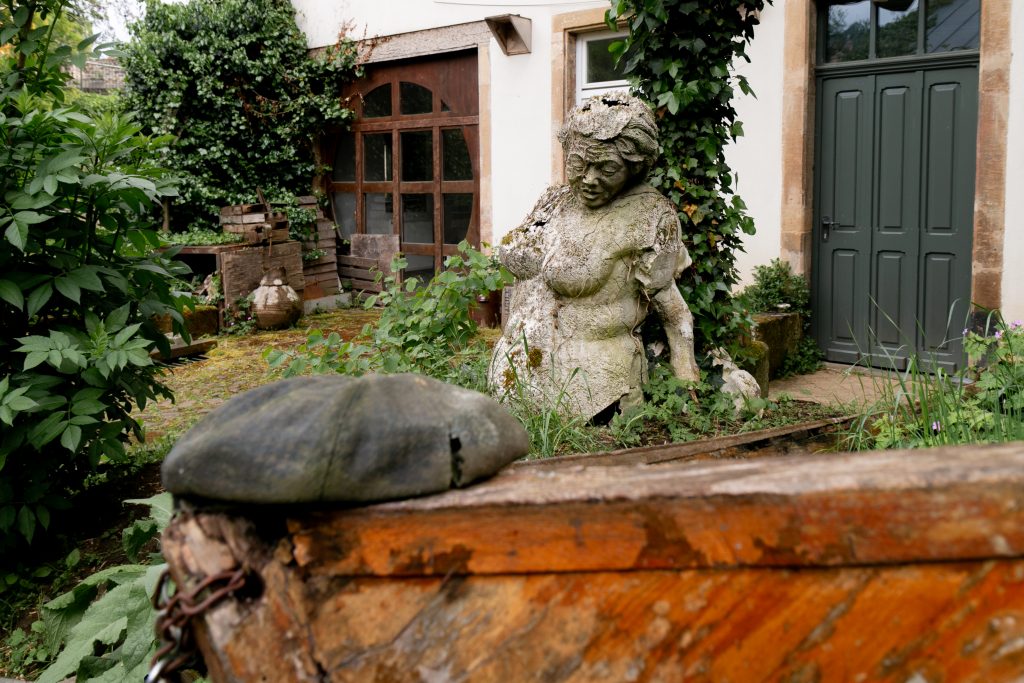
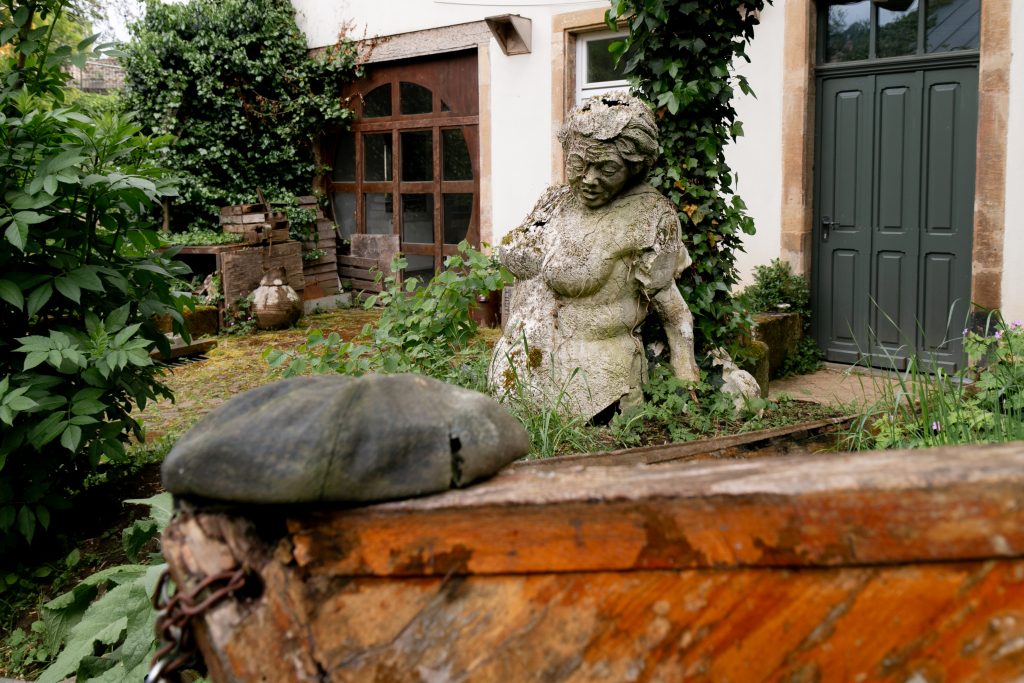
To get to Lofy’s Place, you pass through a door in an old stone wall in the Grund district which leads to a courtyard that feels wild, with its gardens overgrown and moss blanketing the stones beneath your feet. Tanya explains it’s a vast improvement to its previous state. “We had to dig out the whole garden. It was under so much sediment,” as a result of Alzette River flooding in 2021, she says. There are large wood carvings, some that double as seats (one even a carved toilet seat). An abandoned boat sits atop a garden bed, itself now covered in greenery. When Wil lived there, this was a place where artists and art lovers gathered for barbecues,
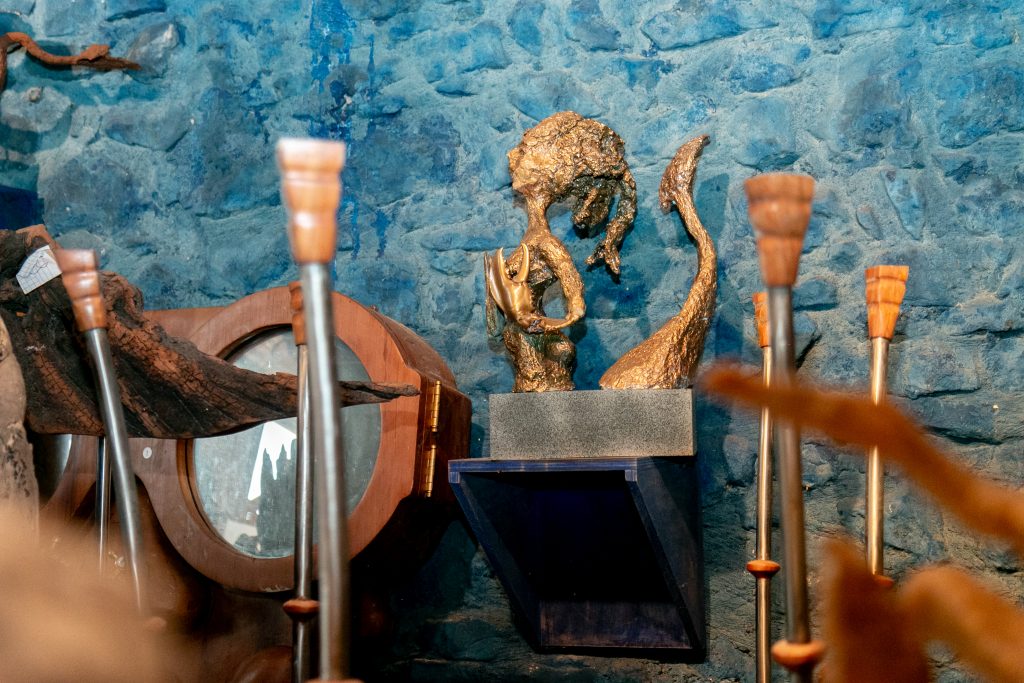
One of the plastered figures is the upper portion of a woman’s body, which served as the basis for Wil’s “Botterfra” (Butter Woman) statue, the bronze version of which now stands in the heart of Ettelbruck. The plastered version has partially dissolved as a result of being left out to the elements, including Alzette River flooding. A hardened flat cap rests on top of her head. As Tanya explains, her father used real clothing to design the piece, plastering it to the structure so that the eventual bronze version later had realistic clothing, folds and all. A similar cap can be seen on the boy next to the butter woman in the bronze version.
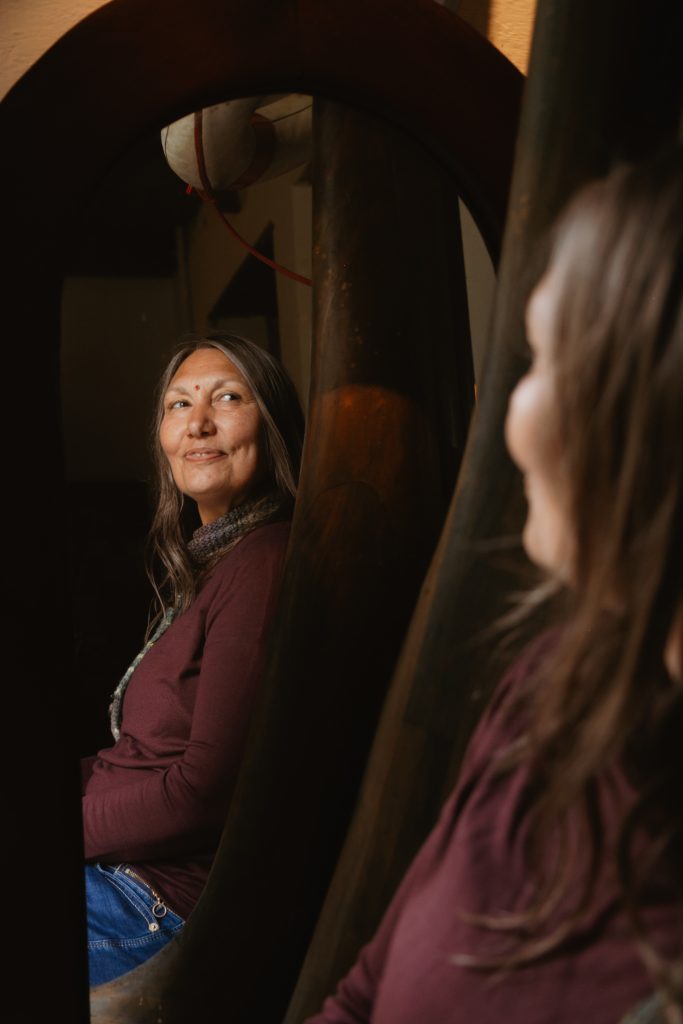
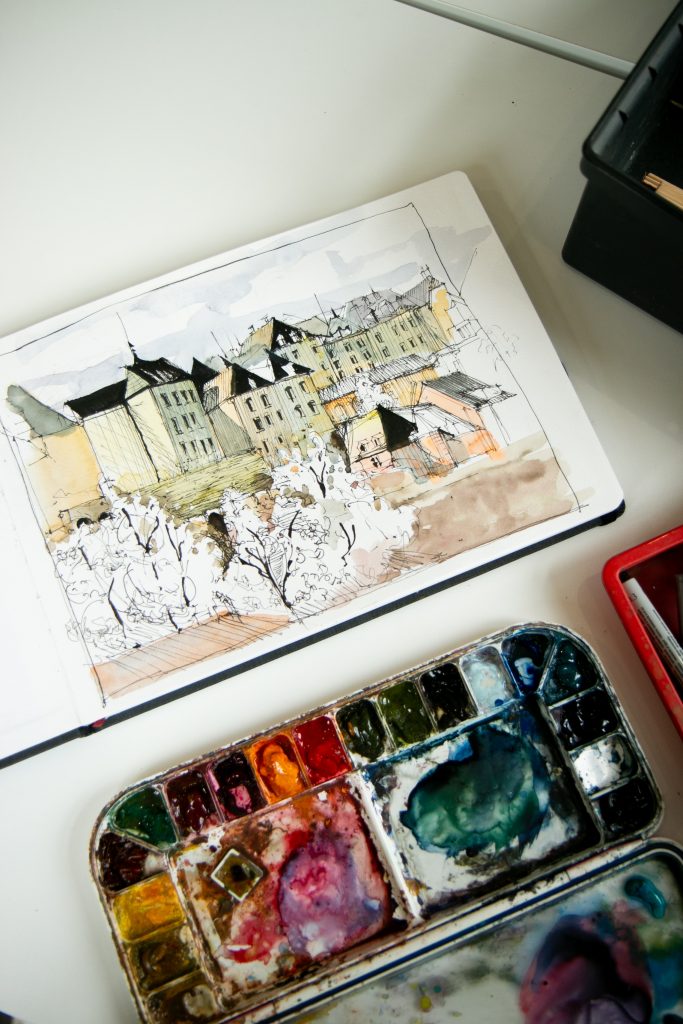
Tanya first takes us into the smaller building, which once served as Wil’s gallery. For now, it serves as a storage space for many of his works, some of which are made on driftwood he brought back from his travels in Patagonia. Inside his former home, there’s the smell of fresh paint and souvenirs from his travels. The upstairs floor is where artistic workshops have already started, thanks to Tanya and the rest of the Lofy’s Place team that worked for months on renovations. On the table is a watercolour and ink sketch of the Grund, made by Tanya. Her father definitely had an artistic influence on her: “He kind of blew my mind open, really, in the way of how to see the world,” she explains.
An unconventional lifestyle
Tanya describes her father as adventurous, free-spirited and rebellious. Though she grew up with her mother in England, Tanya visited him sometimes in Luxembourg. “He was very wicked,” she says with a laugh, describing his mischievous sense of humour.
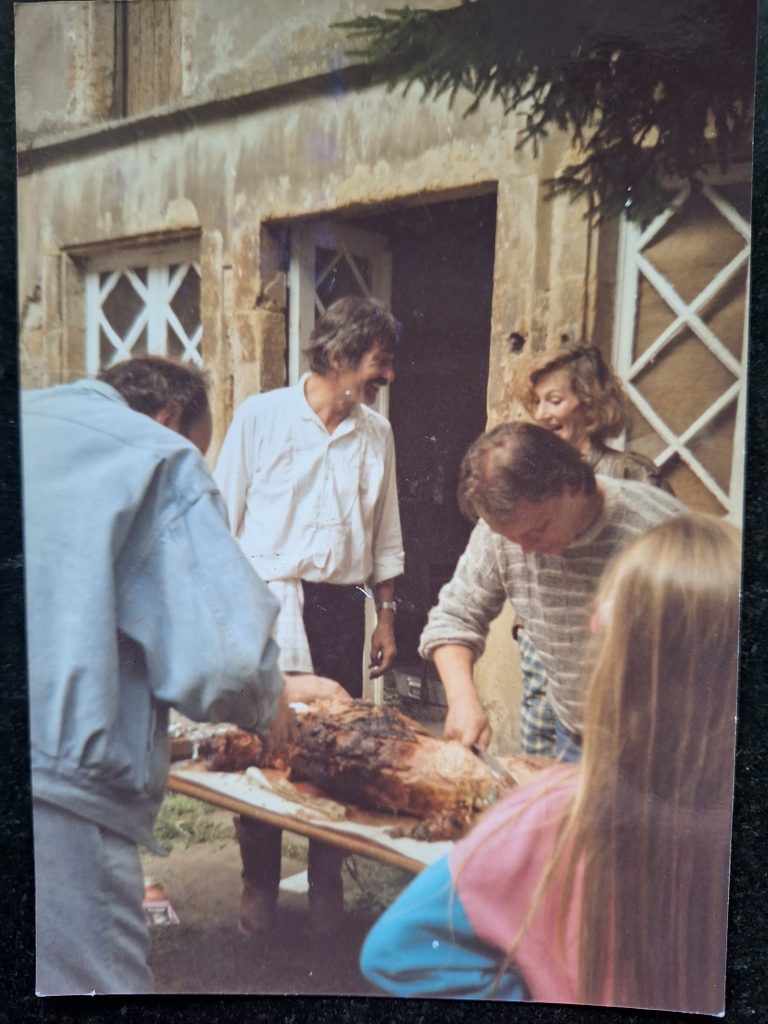
He also had an unconventional parenting style: Tanya recalls some of the adventures she got into with him as a teenager, including risky boating experiences or having to hitchhike home. Though chaotic, these experiences pushed Tanya out of her comfort zone and just another part of free-spirited nature.
Wil was an avid traveller and loved being on his boat. After selling his home in the 1990s, he purchased two remote islands off the coast of Chile, having fallen in love with the sailing and seascape around Cape Horn. “It’s difficult to live on an island in Chile,” Tanya explains. “It’s wild, but beautiful… with those deep-sea blues.” She talks about the wildlife there: the dolphins, penguins and sea lions, along with the swooping of Andean condors overhead.
Tanya inherited the two islands, one of which she has managed to sell, the other of which she is trying to sell. Though living on the island might sound like a dream, realistically, she says, “you need big dogs and a gun” for protection.
Preserving a legacy
Despite minimal financial support and years of difficulties surrounding the property’s ownership and maintenance, Tanya is getting support from friends and volunteers, as well as from the Ville de Luxembourg and generous private donors. Her vision for the site includes a sculpture garden, rotating exhibitions of her father’s work, and hosting art workshops. “What I’d really like is to create an artistic community that comes here to work,” Tanya adds. Although the initiative has required a lot of personal investment, both in terms of money and labour, she’s committed to preserving her father’s legacy and developing a similar artistic community to the one her father had when he lived there.
The studio opened “for individual artistic practice in a calm and inspiring environment” and the first programme of art classes kicked off in mid-April. For now, there isn’t a fixed opening schedule, so it’s best to contact Lofy’s Place in advance (lofysplace.lu).
Meanwhile, for those interested in seeing more of Wil’s interpretations of Patagonia, the Villa Vauban will host an upcoming exhibition, “The other side of Wil Lofy (1937-2021): In Patagonia”, from 28 November 2026 through 23 May 2027.
This article was published in the 10th edition of Forbes Luxembourg.
Read more articles:
A Forest That Sings: Meet The Luxembourgish Artist Behind These Impressionist Paintings