

Premium speed pedelecs as an answer to traffic jams. That’s the vision of Maarten Baert – an architect in the literal sense – and founder of Specter, a Belgian company that embodies the fusion of design, technology, mobility, and sustainability.
At 36, Maarten Baert juggles a packed schedule. Our interview takes place over the phone while he speeds along German motorways en route to yet another meeting to expand Specter’s distribution network. Life moves quickly for the brand’s creator – and that’s not just a nod to his speed pedelecs. While his bikes can reach a top speed of 45 km/h, that’s far from their only selling point. Specter stands out for its unique blend of technology, design, performance, and aesthetics. Specter’s speed pedelecs are strikingly elegant – but could we really expect anything less from an architect who ventured into the world of mobility?
Starting Capital
How does an architect end up designing and producing an electric bike? Maarten Baert: “I’ve always been fascinated by vehicles, boats, bicycles. As a child, I sketched countless 3D models and dreamt of building my own car. During my architecture internship, I quickly realised it wasn’t my calling. I loved the training, but I couldn’t see myself working in an architecture firm. I went freelance in advertising, then soon launched my own business. With my graphic design agency, Divide, we mainly worked with the automotive sector.”
“If you want people to give up their cars, you need to offer them a real alternative”
It was in this context that Baert became aware of the major turning point in mobility. Big cities were facing growing traffic jams, noise pollution, and emissions. Meanwhile, electric bicycles were gaining ground as an alternative to cars. “If you want people to give up their cars, you need to offer them a real alternative,” Baert stresses.
Demand for speed pedelecs was rising, but existing models were often heavy, bulky, or had limited range. The architect in him set out to create a bike that was not just fast, but also light, elegant, and sustainable. Specter was born.
“A friend and I first built a prototype that had nothing to do with our current model,” Baert jokes. That was the first step, and the ambition to go further only grew. A first round of funding brought in over €1 million, thanks to grants from Flanders Innovation & Entrepreneurship (VLAIO). This summer, a second campaign doubled that initial capital. It attracted early investors, including Dutch mobility-focused fund Fundracer Capital, whose members include renowned figures such as René Wiertz (formerly of 3T), Andy Ording (formerly of ZIPP), and Gérard Vroomen (formerly of Cervélo). These experts offer valuable advice to Specter and help expand its distribution network. “It’s hugely motivating because they understand our vision. In the long term, they are invaluable.”
“The Mobility Transition is Underway”
That long term looks promising. “The mobility transition is underway,” Baert says. “We are only at the beginning of a green revolution in urban mobility. The future of transport is electric, and the bicycle plays a key role.” For his part, Baert is moving forward step by step with Specter. “Being an entrepreneur means solving problems to make things happen. It involves a steep learning curve, but that’s the nature of entrepreneurship.”
A Premium Segment
Specter positions itself firmly in the premium segment of the speed pedelec market. These bikes don’t come cheap: the only current model, the Specter 1, starts at €8,990. With customisation options (height, colour, additional battery), the price can reach €11,000.
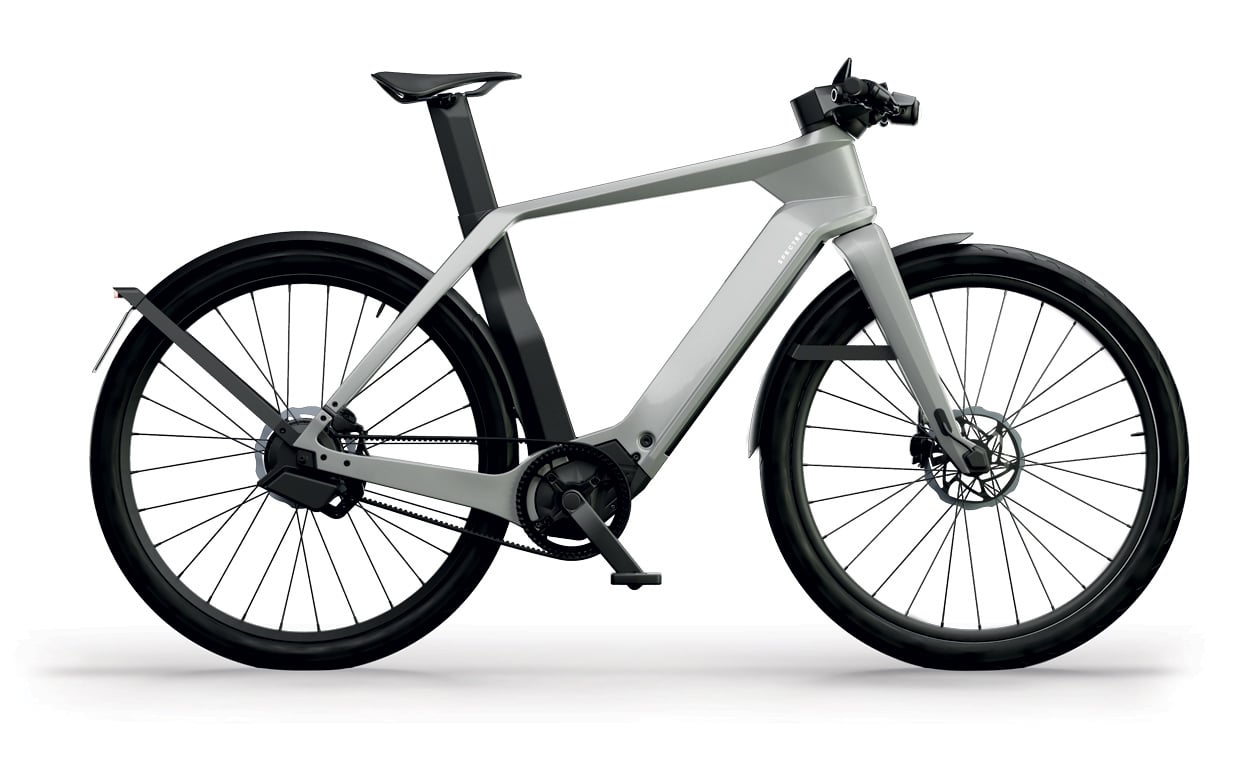
“It’s a deliberate strategy. To stand out, you need to offer something different. I prefer to focus on a niche, because the volume market is already taken. Competing on price alone is impossible – it would require an even greater starting capital given production costs.”
A higher price reflects exceptional design and technology. The carbon fibre frame is both robust and extremely light (under 20 kg). Its integrated display shows navigation or information such as the weather. The battery is discreetly built into the frame, giving the bike a minimalist, clean aesthetic. The powerful motor, capable of reaching 45 km/h, offers a range of over 100 km. The braking system features regenerative braking technology, which not only assists braking but also feeds energy back into the battery. In short – speed and efficiency without compromising comfort.
Many components are designed by Baert himself, while motors and batteries come from renowned suppliers. Today, the bikes are assembled at Specter’s facilities in Wondelgem, near Ghent. The brand is sold in over 40 shops in Flanders and Brussels, with four dealers already in Switzerland. The Netherlands, Germany, France, and Spain are also on the roadmap.
Licensing and Regulation
In Belgium, the speed pedelec is classified as a moped. Authorities define it as: “Any two-wheeled pedal vehicle, excluding motorised cycles, whose pedal assistance enables it to reach a maximum of 45 km/h. The speed pedelec looks like a conventional bicycle or e-bike but is legally a moped.”
As a result, it is subject to strict regulations and licensing. “That’s right, there are a lot of rules and checks,” Baert concedes. “But it’s logical – it’s about everyone’s safety. Traceability of all parts is also essential.”
Alongside expanding its distribution network, Specter is planning to develop new models. Baert takes inspiration from Elon Musk, who started with high-end vehicles before introducing more affordable ones. “We’re following a similar strategy, but I wouldn’t compare myself to Musk or Tesla,” Baert smiles. “Our Specter 2 will target a different price segment, but first we want to strengthen our presence. It feels like we’re at a pivotal moment.”