
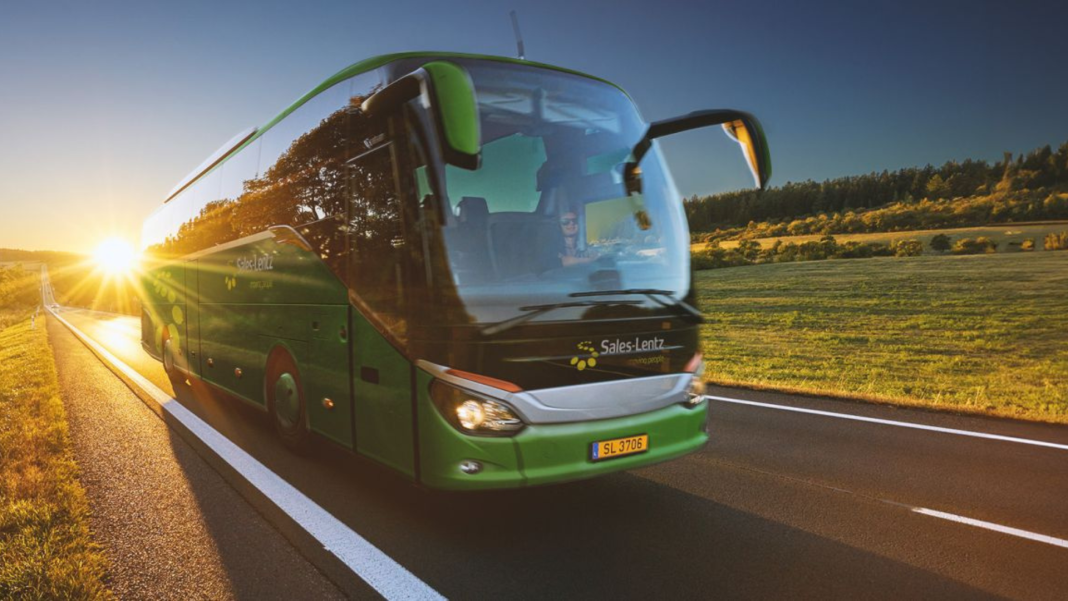
From a family-run bus operator to a European mobility platform, Sales Lentz Group (SLG) has reinvented itself. The sale of a stake in Flibco signals a decisive shift beyond owning fleets.
When Jos and Marc Sales took over the company in the early 2000s, the group had around 185 employees and focused mainly on public transport, private transport, and travel agencies. Twenty years later, SLG employs nearly 1,900 people and operates in several countries, notably Luxembourg and Belgium.
Jos and Marc Sales grew up in the family business, surrounded by buses, offices, and drivers, so the takeover of the group happened naturally. Their parents handed over all shares and operational responsibility to them early on, giving them the freedom to evolve the model. “The desire to reinvent ourselves is the foundation,” summarises Jos Sales.
The group’s growth has come through the gradual expansion of its scope. In Belgium, SLG developed Voyages Léonard and a large tour operator. In Luxembourg, the growth of public transport has led to a continuous increase in volumes and fleets. This expansion has been accompanied by heavy investments, particularly in hybrid and electric vehicles. Since the pandemic, and because of rising energy costs linked to the war in Ukraine, these investments have weighed more heavily on the traditional model, which was based on operating fleets and concessions. “Before Covid, we had the illusion that we weren’t putting all our eggs in one basket,” notes Jos Sales.
Flibco: a new growth driver
At the same time, an internally created activity began to take on a central role: Flibco, a platform conceived and developed within the group with the aim of creating a model distinct from that of a traditional transport operator. “If there’s low cost for planes, why not for buses?” explains Marc Sales.
Flibco positions itself around transfers between city centers and airports. The company owns no fleet. It operates as a platform, relying on partner carriers while managing technology, ticketing, pricing, and traffic optimisation. “Flibco was always developed as something separate,” says Marc Sales.
The company serves several European hubs, including Charleroi, Milan, Turin, Stansted, and Frankfurt. Economically, the shift is clear. Traditional transport now accounts for just over a third of the group’s activity. Another third comes from Flibco. The rest is generated by tourism and the Belgian subsidiaries. Flibco transports around four to five million passengers per year and is targeting ten million.
Enter Flix and the acceleration of the platform model
SLG and Flix had been in contact for nearly fifteen years before joining forces. “The European mobility market is small, we run into each other everywhere,” observes Jos Sales. Flix operates intercity routes; Flibco handles airport transfers.
At the end of 2025, Flix acquired a majority stake in Flibco. The deal concerns technology, the team, and market position, not physical assets. Unusually for Flix, it is not acquiring 100% of the company, “a first in their history,” points out Marc Sales. The family is retaining a very large share of the capital and a veto right, and maintaining Flibco’s headquarters in Luxembourg was one of the non-negotiable conditions from the outset: “we’re playing the Luxembourg card,” summarises Jos Sales, referring both to keeping the legal structure in the country and to discussions with Luxembourg authorities regarding the European development of the platform.
For Flibco, the deal brings European firepower. “Flix will help us move faster,” says Marc Sales, referring to accessing the German group’s networks, permits, and suppliers. Operational leadership remains based in Luxembourg under Tobias Stüber and his teams. The expected impact is quick. Flibco is planning accelerated expansion and a doubling of its workforce in Luxembourg within 12 to 18 months. For SLG, the platform model is becoming central.
While bus transport remains a structuring activity, the group’s value now also lies in its ability to organise mobility flows at a European scale without owning a fleet. “In ten or fifteen years, it’ll be a different industry,” anticipates Jos Sales. “What matters to us is that the company remains solid, sustainable, and human.”
Read more articles:
Robert Goeres And The Business Of Slowing Time
Inside Kaempff-Kohler’s New Era
Earnings Growth Expected To Rise In 2026, Says EFG Chief Investment Officer
