
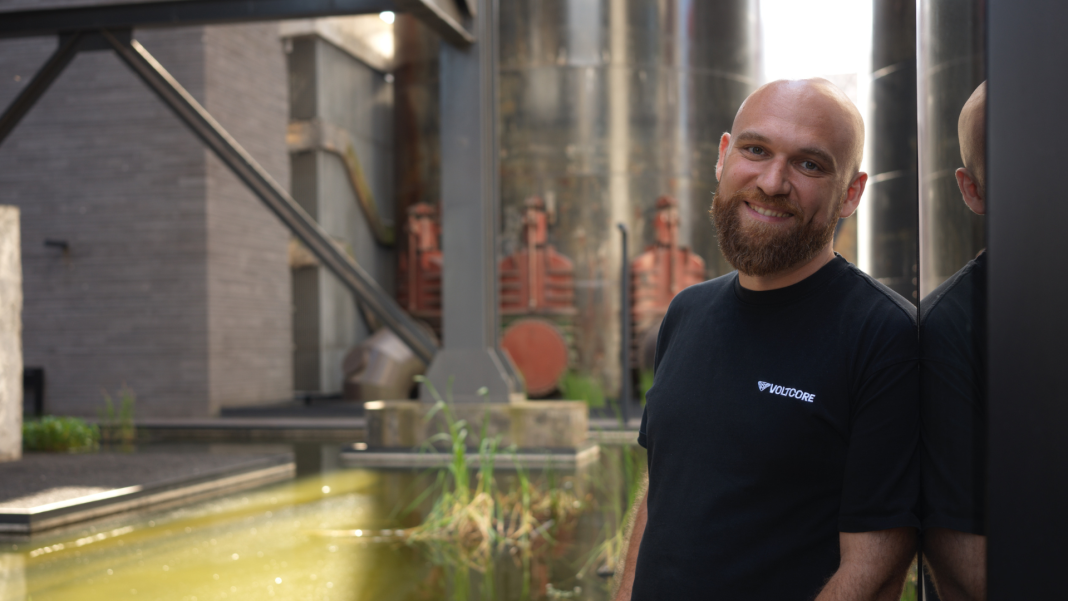
Despite some setbacks before launching in Luxembourg, Voltcore has developed industrial-scale production capabilities in the country and is preparing to move to a new facility in Bissen. CEO and founder Vlad Batkhin reveals more.
Voltcore’s Luxembourg story began in December 2023 in what Batkhin refers to as a sort of “reverse roadshow”. Previously based in Israel, Batkhin knew he had to take action after the Gaza war began, as it imposed travel restrictions to the country, making it difficult to conduct business—including for potential automotive sector clients he’d wanted to reach. “We took a road trip through Paris, Luxembourg, Stuttgart, Munich and Vienna, checking the startup environments,” he explains. “A big reason for us to settle here was because of our partners and supporters.”
Among the partners is Technoport. Batkhin was so impressed with the degree of personalised, on-demand service he received that by summer 2024, Voltcore formally joined the Technoport programme. Then, in December, Voltcore became one of three new companies, alongside Pony.ai and Right Energy, to join the Bissen “Automobility Campus”—a €40 million government-backed incubator with state-of-the-art facilities and capacity to host around 4,000 people.
Now in Foetz, Voltcore has enabled itself to have industrial-scale production although, as Batkhin explains, “We still don’t need this full scale because the process of validation and homologation of our products with key customers takes time, while it is crucial to have an industrial facility to pass [the] certification process and be capable to fill our early adopters’ orders. We’re working more on proof-of-technology at customer sites, with big names in the automotive market in Europe, the US and Korea. ”
With the eventual move to Bissen, Voltcore will install its own capacity for conductive polymers and heating filament production.
Traction in the automotive market
Voltcore’s innovative technology makes it possible for ultrathin polymer filaments to have electrical conductivity properties, offering a wide range of benefits: they’re more affordable than last-generation, metal-based heating solutions while also being more energy efficient and eco-friendly.
Although the technology has a vast range of potential uses—in outdoor, athleticwear and food delivery, for instance—Voltcore’s focus historically has been on two key sectors with bigger volumes and higher impact: construction and automotive. For now, however, “It seems that automotive is bringing a way bigger opportunity for us because of electrification and reduced driving range for e-vehicles during the wintertime, and we can significantly improve that because our material is more energy effective than classical systems,” the CEO adds.
It has also been easier for Voltcore to develop firm engagement and pilot projects with key automotive players, which has not been the case for construction. Batkhin adds that there’s a “real appetite for innovation” in the automotive sector, since European carmakers push themselves to innovate faster to remain competitive in the face of rising dominance of Chinese brands.
“Since we started actively targeting this segment around a year ago, we conducted numerous projects with carmakers and Tiers have been approved for technology roadmaps within them, and even for a new BEV demo car,” Batkhin adds. “We also got to the finals of the most prestigious competitions of Paris Motor Show and GAMIC in Michigan, and also recently won Hyundai’s start-up competition.”
In its last round of fundraising, Voltcore developed its team and continued moving forward with its investment plans. It already has some “small but nice contracts” in mobility. In 2024, Voltcore also created what the CEO calls “a fantastic advisory board”, which includes former executives from the automotive and polymer sectors.
Plans for early 2026 will be to convert as many of Voltcore’s pilot engagements as possible into confirmed projects for specific programmes and models, and Batkhin has set a goal to work with two or three major tiers in implementation of Voltcore’s materials in their product portfolio to generate solid, continuous revenues
Read more articles:
SolarCleano: Solar Farm Cleaning Robots