
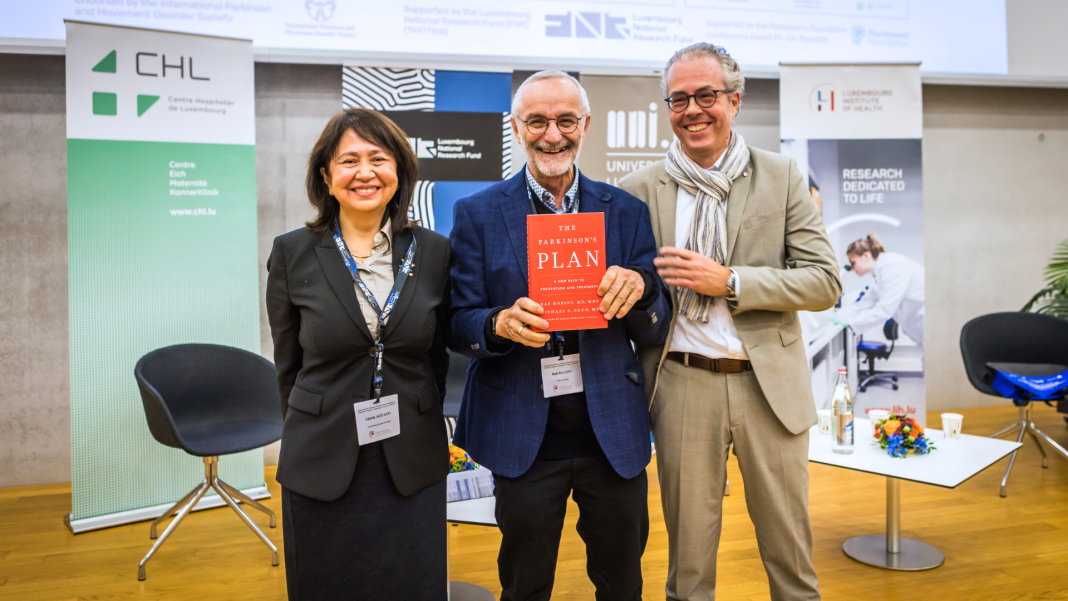
Ten years after its launch, Luxembourg’s National Centre for Excellence in Research on Parkinson’s Disease (NCER-PD) has quietly engineered one of Europe’s most successful neuroscience programmes—and put the Grand Duchy on the global research map.
When the Luxembourg Centre for Systems Biomedicine (LSCB) was set up as part of the University of Luxembourg in 2009, founding director Rudi Balling was given carte blanche when it came to strategy and focus. “We can’t do everything,” he pointed out, “so I was pondering what the best disease area would be to focus on.” Other neurodegenerative diseases like Alzheimer’s or Huntington’s were in the running as potential focus areas, he said, but “Parkinson’s was the one where you had the most genetic information.”
Parkinson’s disease, which damages nerve cells and leads to problems with movement, tremors, and impaired balance, affects up to 4,000 people in Luxembourg. It is less frequently seen than Alzheimer’s disease but much more common than the very rare Huntington’s disease. “I counted the genes at the time that were known, and it was about 15 known familial Parkinson’s genes, compared to three known Alzheimer’s genes,” explained Balling, now a professor at the University of Bonn. “The math was easy! Fifteen beats three.”
Creating a “culture” of research
The National Centre for Excellence in Research on Parkinson’s Disease (NCER-PD) kicked off in 2015. Since then, the programme has established a nationwide cohort of people with Parkinson’s. “That was my responsibility,” said professor and NCER-PD coordinator Rejko Krüger. It involved the collection of clinical and neuro-psychological data, as well as samples of blood, urine, and saliva. “This is now the basis for data-driven research, experimental research, and bio-marker research.”
A “culture” of research didn’t really exist in Luxembourg at the time, continued Krüger. “People weren’t used to taking part in research. It’s different from countries where there’s a university hospital, where people join clinical trials. Here, it was really to create confidence, to invite people, to guide people, to lead people in research. That was really – for me, as a clinician – a very nice experience, how this was taken up in Luxembourg. Now, more than 2,000 people come regularly to our research clinic and donate samples.”
Research is about more than just publishing papers, emphasised Balling, and public involvement is key. The Parkinson’s programme, for instance, has served as a “bridge” to associations, patients, relatives, and caretakers.
An “integrated care network” called ParkinsonNet has also been set up, said Krüger, with 100 professionals trained specifically in Parkinson’s across several disciplines. The network has been integrated into the Luxembourg healthcare system for two years. “Everybody with Parkinson’s can benefit from access to the best possible treatment in Luxembourg – they don’t have to go to Brussels, Paris, Berlin. We can implement new findings from research directly.”
Access to innovative treatments
The Luxembourg Parkinson’s cohort enjoys “worldwide renown,” Krüger added. A “brain bank,” which allows people to donate their brains after their death, has been set up within the NCER-PD. And thanks to the programme’s research, “we have found the most common genetic cause for Parkinson’s here in Luxembourg.”
The glucocerebrosidase gene, or GBA, encodes an enzyme that helps clear dysfunctional proteins from cells. But if this gene has a mutation, then cells can’t get rid of protein waste – and they degenerate. Twelve percent of people with Parkinson’s in Luxembourg develop the disease because of a mutation in this gene.
Parkinson’s can’t be cured, but treatment can slow disease progression. “We’re especially proud of getting access to treatment innovations,” said Krüger. “We have already taken part in one study where an antibody infusion is given to eliminate the protein that is accumulating in the brain.” A study will be launched in the autumn for people who have a GBA1 mutation, with the aim of preventing cognitive problems.
Looking ahead: early treatment and prevention
Patients in Luxembourg can participate in clinical trials, said Krüger, testing medications before they hit the market. Thanks to an “open label extension,” the Luxembourg patients who were involved in the clinical trial for an antibody that can potentially slow the disease can continue taking the medication, even if it’s not yet available to the wider public. Another example is a “pump” attached to a patient’s teeth that can deliver medication.
Other disease-modifying treatments are in store for next year, Krüger added. “We are collaborating with a small pharma company from Finland that wants to test a drug that could slow down disease progression,” he said. “We see that Luxembourg is accepted and that we can play in the same leagues as university hospitals in the international context.”
Also on the agenda is a study on REM sleep behaviour disorder. The disorder – which causes people to shout, run or even box during their sleep – is associated with developing Parkinson’s disease. And since Parkinson’s develops over many years, this could enable people to be treated before they present neurological symptoms.
What’s true for Parkinson’s disease may also be true for Alzheimer’s and may, in turn, be true for other neurodegenerative diseases, said Balling. In the future, less emphasis should be placed on differences and more attention paid to similarities.
“The future will be in early treatment, disease modification, and prevention,” Krüger concluded. “We should not underestimate the potential. We can prevent 45% of dementia cases if we only act on the risks.”
A conference to celebrate 10 years of the NCER-PD will take place on 16-17 October. Find out more here.
Read more articles:
OrganoTherapeutics: Reimagining Parkinson’s Research
Luxembourg’s Paradox: World-Class Health, But A Generation At Risk
Astrobiome: Using Space To Transform Gut Health And Agriculture
