

At the Bloomberg Luxembourg Investment Summit 2026, policymakers and investors connected Europe’s security ambitions with capital allocation, while examining AI-driven growth, cybersecurity risks and the changing role of financial technology.
At the Philharmonie Luxembourg on 1st October 2026, the Luxembourg Investment Summit examined the investment questions behind Europe’s defence and technology ambitions: how to finance production, where AI spending will generate returns, and whether institutions can secure the technology they adopt.
“Innovation needs to be financed,” said Defence Minister Yuriko Backes.
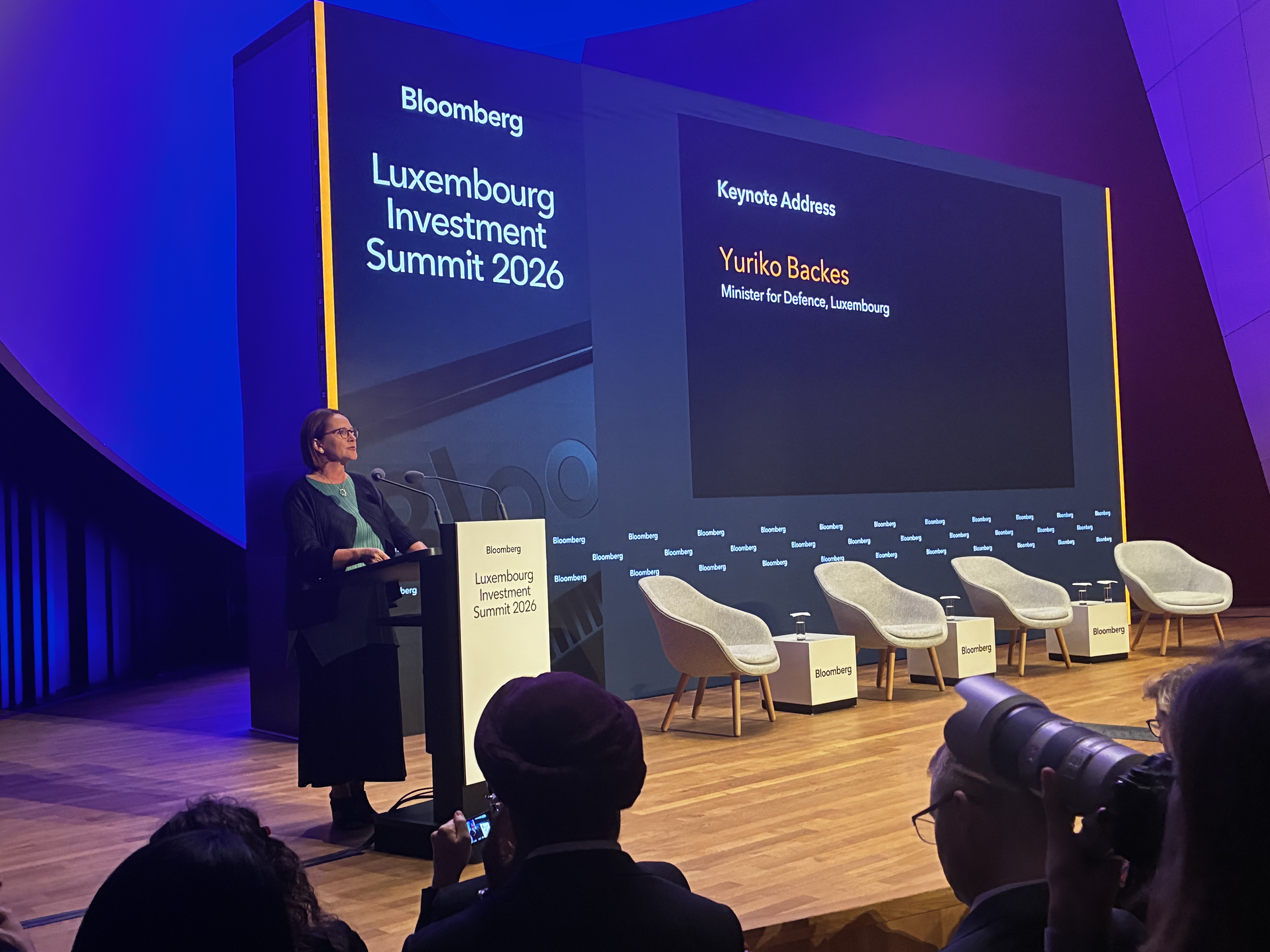
Funding innovation is only the beginning. Companies must scale up, investors must assess returns, and institutions must manage fast-changing technology. Opening the summit, Denis Andreev, Bloomberg’s director for Luxembourg and Belgium, emphasised its role in connecting capital, investors and ideas.
Financing Europe’s capacity to act
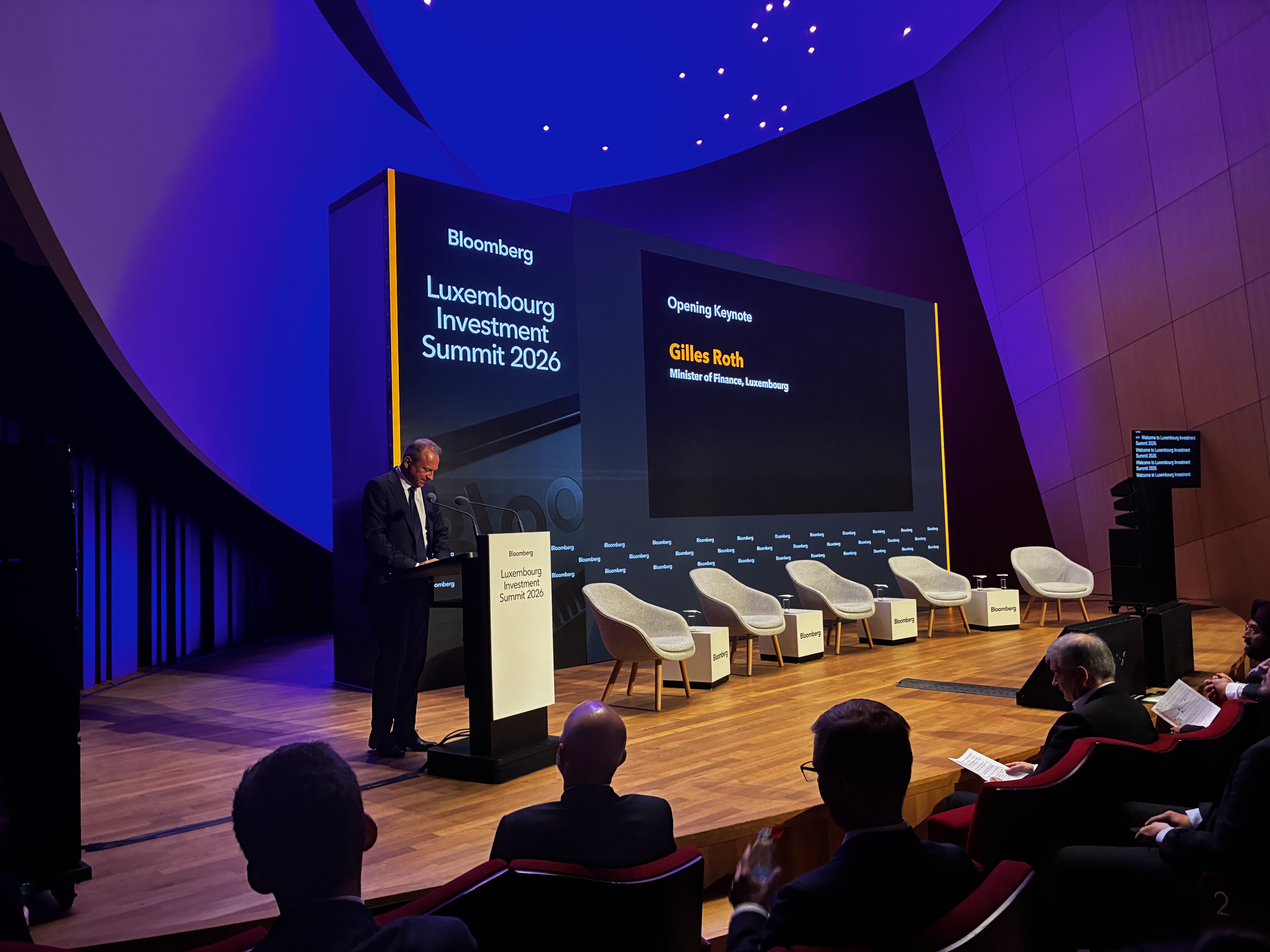
Finance Minister Gilles Roth framed the state budget as an investment in Luxembourg’s future, connecting the allocation of public resources with the decisions investors make every day. Ahead of the presentation of the 2027 draft state budget, scheduled for 7 October 2026, he stressed the importance of keeping Luxembourg a stable, predictable and trusted partner in an increasingly uncertain geopolitical environment.
Defence, energy, cybersecurity, AI and digital infrastructure require substantial investment. European companies also need capital to start, grow and scale within Europe. Minister Roth connected those financing needs with Europe’s capacity to act: the allocation of resources today shapes the capabilities and freedom of action available tomorrow.
“Finance has to flow to where it is needed,” said Minister Roth.
Luxembourg’s €150m Defence Bond was fully allocated in less than a day after subscriptions opened in January. Luxembourg is working with Canada and other international partners towards establishing the Defence, Security and Resilience Bank to mobilise long-term financing.
Uncertain markets, urgent investment
The macroeconomic discussion explored how investors should allocate capital when growth, inflation and geopolitics send conflicting signals. AI investment can support economic activity, while conflict and energy disruption can renew inflationary pressure and complicate the outlook. The exchange examined scenario planning, sovereign debt pressures and changing relationships between bonds and equities, raising a practical question: how resilient are portfolios if economic conditions depart from expectations?
The panel included Helen Belopolsky, global head of geopolitical research at Deutsche Bank; Julienne Daglish, CEO of Lloyds Bank Corporate Markets Luxembourg; Nicolas Forest, chief investment officer at Candriam; and Livia Moretti, CEO of Banque de Luxembourg. Jacqueline Simmons, editorial lead for EMEA at Bloomberg News, moderated the discussion.
Capital on the defence line
Defence presents a particularly concrete financing challenge. Sander Verbrugge, partner at the NATO Innovation Fund, and Alex Kokcharov, Bloomberg’s geoeconomics analyst for Russia, examined what it takes to turn defence innovation into production.
Venture funding alone does not resolve the working-capital needs of a company building and delivering equipment. Debt financing, dependable demand and procurement signals also matter. Partnerships with established manufacturers can bring certification and production expertise; Ukraine’s rapid innovation cycles underline the pressure to move faster.
A Dealroom and NATO Innovation Fund report found that European defence, security and resilience start-ups raised US$8.7bn in venture capital in 2025, up 55% year on year. The panel’s discussion addressed the next challenge: complementing venture capital with financing that enables companies to manufacture and deliver equipment.
Minister Backes placed defence investment within Luxembourg’s responsibility to protect its sovereignty and contribute to collective defence and deterrence. Financial commitments must translate into operational capabilities, supported by an industrial base able to develop and deliver new technologies. Luxembourg’s defence industry strategy prioritises innovation in space, cybersecurity, autonomous systems, AI and advanced materials, with research and development supported through national, European and NATO programmes.
The National Defence Fund, launched on 30 April 2026, with €150m over five years, supports innovative defence and dual-use companies. The Société nationale de crédit et d’investissement implements the fund. Minister Backes linked more resilient supply chains with a stronger European pillar within NATO. “However, autonomy does not mean isolation,” said Minister Backes.
AI’s promise meets its costs and risks
The same questions about investment and delivery run through AI. Mandeep Singh, global head of technology research at Bloomberg Intelligence, drew attention to the gap between AI infrastructure spending and monetisation. Computing demand strains components and data centres; applications must generate revenues. Coding agents stand out among uses finding commercial traction.
Agentic workflows can consume more computing resources than simple chatbot interactions. Adoption can therefore increase demand and operating costs together. For investors, this matters: rising expenditure on infrastructure does not establish which businesses will capture the returns.
Marx on managing AI risks
Financial institutions face an additional challenge: deploying these systems safely. Claude Marx, general director of the Commission de Surveillance du Secteur Financier, addressed the widening gap between rapid advances in AI and institutions’ established timelines for modernising systems and fixing vulnerabilities. Smaller organisations face particular constraints when they lack specialist resources, strategic direction and support from a larger group.
The supervisory concerns extend beyond cybersecurity. Model reliability, data quality, operational resilience, third-party concentration and financial crime all require attention, alongside accountability for decisions involving AI. Marx also pointed to AI’s potential to support supervisory work, while making governance central to managing its adoption.
“It is important that boards and executive teams understand frontier AI risks,” said Marx.
That understanding must translate into strategic direction and oversight of how control functions manage the risks. For financial institutions, adopting AI therefore requires both technical expertise and informed leadership.
New tools, new risks
The cybersecurity panel examined how AI changes both the threat landscape and the systems organisations must protect. Pascal Steichen, CEO of the Luxembourg House of Cybersecurity, addressed the pressure created by models that discover software vulnerabilities rapidly, leaving companies less time to develop and implement fixes. AI can also support defensive work, making coordination between technology and human expertise increasingly important.
Frederiek Van Holle, chief technology and operations officer at Indosuez–DPAM, examined the operational implications of introducing agents into internal workflows. Giving these systems access to tools creates risks within the organisation, particularly when external information can influence their actions. Managing permissions and controlling how agents interact with systems become essential considerations.
Pascal Bouvier, managing partner and co-founder of Middlegame Ventures, distinguished the protection of cryptographic systems from the vulnerabilities of the people using them. Falling attack costs increase exposure to deception and human error, while interactions between autonomous agents introduce further uncertainty. Mandeep Singh, global head of technology research at Bloomberg Intelligence, moderated an exchange that connected vulnerability management, operational controls and human behaviour.
These concerns also feature in the CSSF’s July guidance, which warns that faster patching alone is insufficient and calls for broader measures to strengthen cyber resilience.
Banking on the future
Lars Kalbreier, group chief investment officer at Quintet Private Bank, and Jacqueline Simmons, editorial lead for EMEA at Bloomberg News, connected defence, energy and technology through strategic autonomy. Their conversation also introduced a valuation question: does the additional yield on long-term hyperscaler debt adequately compensate for uncertainty about technology’s future winners?
The discussion also explored a renewed case for fixed income as yields provide compensation for risk, and the flow of AI investment into physical infrastructure, including energy production and electricity grids.
The discussion returned to implementation with Rob Gee, Bloomberg’s head of market specialists for EMEA, who introduced plans to improve the Bloomberg Terminal experience through AI. Polling on production use cases and implementation expectations brought the discussion back to execution: how much AI experimentation is becoming part of everyday operations?
An established annual event, the Luxembourg Investment Summit provides a valuable forum for policymakers, investors and industry leaders to exchange perspectives on the forces shaping financial markets. For participants, its combination of policy discussions, investment analysis and technological expertise offers practical insights into opportunities and risks. For Luxembourg, it showcases the breadth of its financial ecosystem and strengthens dialogue between public institutions and private capital.
Read more articles:
Spuerkeess Appoints Gaëlle Haag As COO In Generational Leadership Shift
Building Luxembourg’s Institutional Crypto Market
The CFO’s New Reality: Every Finance Team Is About To Multiply