
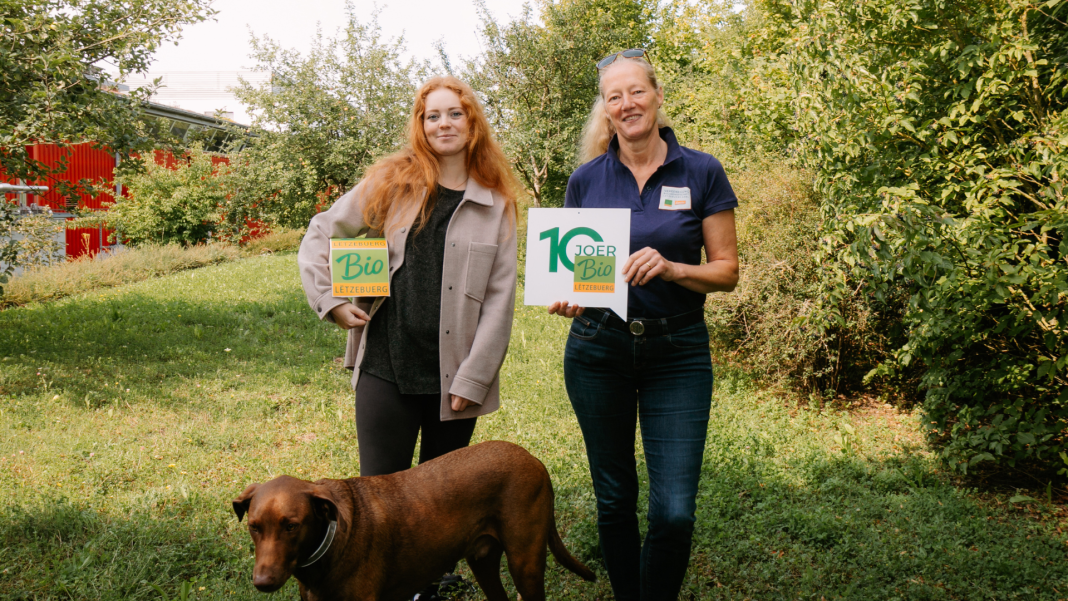
Created in 2015 to support local producers, the Bio LËTZEBUERG (Organic Luxembourg) label celebrates its 10th anniversary in 2025. Since its launch, it has become both an economic tool and a grassroots movement, driven by an engaged community and a sustainable vision of organic farming in Luxembourg.
It all started with only a few farmers, united by the belief that a new path was possible. Ten years later, more than fifty proudly bear the Bio LËTZEBUERG label.
“Luxembourg consumers wanted organic products from local farms, but this particular offering was very limited. We needed a concrete tool to bridge the gap between demand and the realities of our own agriculture,” explains Daniela Noesen, Director of the Vereenegung fir Biolandwirtschaft Lëtzebuerg asbl.
Founded in 2015, this 100% Luxembourgish label was initially intended as a mark of recognition: for producers, a way to highlight their rigorous practices; for consumers, a guarantee of traceability, ethics, and proximity. “It’s a label born from the ground, designed for and by our organic farmers,” she summarises.
A distinctive positioning
In addition to criteria of European organic labels, Bio LËTZEBUERG applies some further standards for local organic farmers who choose to join. Farms must be fully converted to organic agriculture; fertilisation and animal feed are strictly regulated. “This isn’t partially organic, it’s a full commitment,” insists Daniela Noesen. The label is also reserved for members of the association, reinforcing the sense of community. “You don’t buy it, you join it,” she adds. A detail that makes all the difference.

Over the years, the range has expanded, from dairy products to vegetables and meat. This flexibility is fully embraced, yet always within the bounds of a rigorous specification. “Every new request is carefully considered. We move forward together, at the community’s pace. It’s a living label, constantly evolving,” says Daniela Noesen, with enthusiasm.
An economic tool serving producers
Bio LËTZEBUERG doesn’t aim for profit: the association is a non-profit organisation. By structuring a recognisable local organic offering, the label creates value for its members. “It helps with positioning, brings immediate recognition from distributors, institutions, and end consumers,” says Anne Hoffmann, who now supports the organisation alongside Daniela Noesen and may eventually take over its leadership.

The model is participatory: the members are the primary decision-makers. Every change or expansion is voted on. “It sometimes takes more time, but it ensures the project’s coherence. And above all, it strengthens the sense of ownership,” adds Anne Hoffmann.
A driver of impact beyond the fields
Because the ambition of Bio LËTZEBUERG goes beyond agriculture: through this label, “a true way of living is taking shape,” says Anne Hoffmann. A model based on respect for nature, transparency, sustainability, and – perhaps above all – solidarity. “We are not a static label. We are a living, democratic community where ideas circulate and everyone has a place.”
“We are a living, democratic community where ideas circulate and everyone has a place”
In a context of widespread anxiety – ecological crisis, inflation, geopolitical instability – this approach clearly resonates. “Organic farming offers concrete answers. It protects soil, water, and biodiversity while providing healthier food. The label makes these choices visible and integrates them into a collective effort,” says Daniela Noesen.
A future-focused vision
Far from resting on its laurels, the team is already looking ahead to the next ten years. The goals are clear: strengthen the label’s presence in canteens, hospitals, and schools; raise awareness among new audiences; collaborate with engaged municipalities. “The potential is there. Now it’s up to consumers to demand more Bio LËTZEBUERG products so that distributors follow,” notes Anne Hoffmann.

To achieve this, the association is betting on education: starting with the “Bio-Woch”, the next edition of which will take place in September 2025, along with video capsules, public events, and more. “Beyond bringing people together, our role is also to educate. Each labelled product tells a story, that of people committed to a different way of producing. And that has real value,” reminds Daniela Noesen.
Bio LËTZEBUERG at the heart of a growing organic landscape
Since 2018, organic agriculture in Luxembourg has shown steady and measurable growth. According to the national action plan PAN-Bio 2025, the country recorded a 57% increase in organic farmland between 2018 and 2022, reaching 8,460 hectares, or 6.9% of the total utilised agricultural area (UAA). This progression reflects an average annual growth rate of around 10% over the period. The government’s ambition is to raise the share of organic land to 20% by the end of 2025.
In 2022, the organic farming sector comprised 98 certified organic farmers, 20 market gardeners, 22 winegrowers, 23 fruit producers, 21 beekeepers, and 16 organic poultry farms, according to official data from the Ministry of Agriculture. Among the 98 certified organic farmers, 50 bear the Bio LËTZEBUERG label, which attests to a 100% organic commitment and alignment with national quality standards. Not all organic producers in Luxembourg are part of this initiative, making the label an additional guarantee of traceability and values.

By 2023, the total area under organic cultivation had slightly increased to 8,615 hectares, representing 6.5% of the national UAA. That same year, the Rural Economy Service reported 209 certified organic producers operating across approximately 1,822 farms, confirming the sector’s continuing expansion and structuration.
Luxembourg also ranks among the top EU countries in per capita spending on organic food, despite a relatively limited portion of agricultural land being farmed organically. This gap between demand and supply underscores the importance of strengthening national production. In this context, initiatives such as the Bio LËTZEBUERG label support the visibility and traceability of 100% organic, locally produced food. These efforts help reduce dependency on imports, encourage short supply chains and contribute to building a more sustainable and sovereign agri-food model.
This article was published in the 7th edition of Forbes Luxembourg.
Read more articles:
Meet The Scale-up Closing The $3.5 Trillion Climate Funding Gap
