

ClearSpace has signed a new contract with the European Space Agency to advance Phoenix, its ambitious mission to extend the operational life of satellites in geostationary orbit, technology originally developed by ClearSpace Luxembourg now moving into its next phase with European backing.
The agreement, announced on 22 September, funds the next phase of a programme estimated at roughly €100 million overall. It will push forward the mission architecture and the core technologies (rendezvous, proximity operations, docking and servicing) that Phoenix needs to move from concept toward commercial reality. The work is financed through ESA’s Industrial Competitiveness line within its ARTES programme, placing Phoenix squarely within Europe’s strategic effort to build sovereign in-orbit capabilities.
For Luxembourg, the milestone carries particular weight. Phoenix’s technical foundations were laid by ClearSpace Luxembourg, developed with backing from the Grand Duchy’s government and the Luxembourg Space Agency. That early support gave the company room to prove out the docking concept and demonstrate that satellite life extension could become a viable in-orbit service, well before ESA’s broader industrial base joined the effort. The new ARTES-funded phase builds directly on that groundwork, carrying technology developed in Luxembourg into a wider European programme with the resources to bring it closer to commercial deployment.
At the heart of Phoenix is a docking system designed to let a servicing spacecraft attach securely to an operational satellite already in geostationary orbit. Once connected, the servicer can take over propulsion and attitude-control duties, including station-keeping, repositioning and eventually end-of-life operations. For satellite operators, that translates into extended asset value and, crucially, more responsible management of an increasingly congested orbital environment.
Laurent Jaffart, ESA’s Director of Resilience, Navigation and Connectivity, framed the contract as part of a broader push to mature dual-use technologies with implications for sustainability, resilience and European industrial competitiveness. ClearSpace CEO and co-founder Luc Piguet was equally direct about where credit belongs, thanking ESA, Luxembourg and the Luxembourg Space Agency for support that, in his words, allowed ambitious ideas to be transformed into technologies, missions and increasingly tangible services.
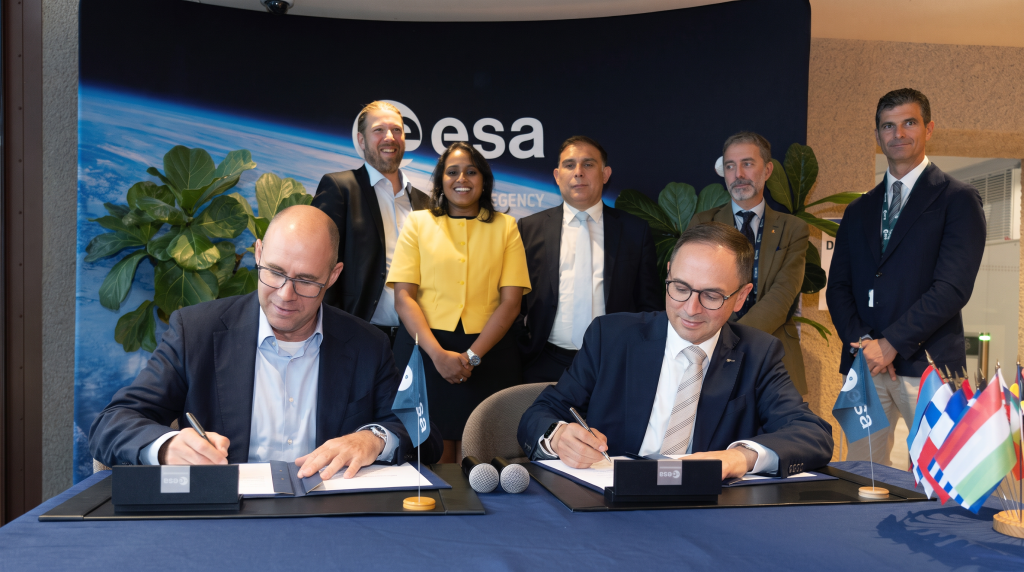
The signing, held in Luxembourg with ClearSpace and ESA leadership present, underscores the return on Luxembourg’s early investment. Technology developed with national backing has now matured to the point of securing a European-level contract, evidence that the Grand Duchy’s space strategy is producing tangible industrial outcomes rather than remaining a policy ambition.
Phoenix now joins a widening ClearSpace portfolio spanning inspection, rendezvous and proximity operations, capture, active debris removal and satellite life extension, positioning the company, and by extension Luxembourg, at the centre of Europe’s push to build a commercially sustainable in-orbit servicing industry, rather than simply importing one.
Read more articles:
Value Partners Joins WPS Global Platform
Reversible Construction Permits: Rethinking The Way Forward?