
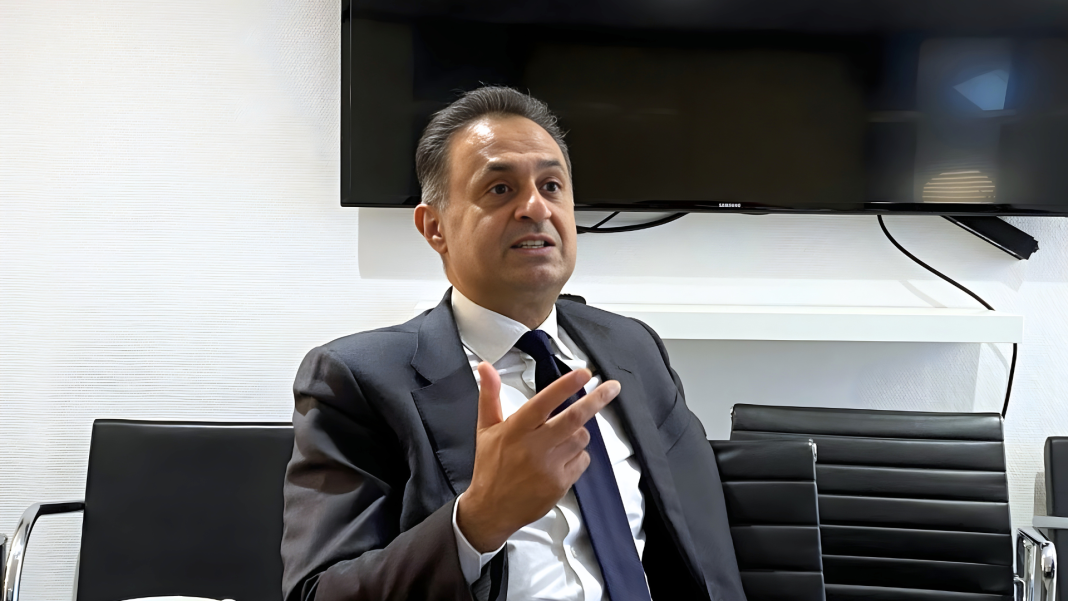
Earnings revisions for 2026 have been “extraordinary,” said EFG chief investment officer Moz Afzal. Thanks to the positive earnings growth picture, Afzal expects the US to lead economic growth this year, but Europe has a few cards up its sleeve.
“The earnings growth picture looks pretty good for 2026.” That’s according to Moz Afzal, global chief investment officer at EFG, speaking Thursday afternoon at the bank’s annual outlook presentation in Luxembourg. Earnings per share growth projections for FY 2026 are strong: 15.1% for the MSCI ACWI Index, which captures large and mid-cap representation across developed markets and emerging markets countries, 15.4% for the US, 11% for Europe, and a staggering 26.2% for Asian countries (excluding Japan).
And if you look at the revisions, how much analysts have changed their projections over a certain period of time, they’ve been “extraordinary,” added Afzal. Asia ex Japan, over three months, has tacked on 11.1% of earnings growth. “So that would have been 15.1% three months ago. Now it’s 26.2%,” he said. Big upward revisions have also been observed for Europe, which has seen an upward revision of 6.3% over 12 months.
But China, Afzal noted, is the only region that has seen downward revisions over the past year. This is because the Chinese economy remains weak, suffering from an over-reliance on exports, demographic issues, and migration challenges. That being said, he added that “Hong Kong looks very good because of the IPOs and improvements in real estate.”
“Overall, the earnings picture looks very healthy,” Afzal said. And while markets may look expensive, that’s due to these “great earnings numbers.” “There’s no such thing as good earnings numbers and cheap valuations. I wish it existed, if you could find it for me, I’d be a billionaire very quickly! But the reality is, there’s no free lunch: you get expensive valuations, [but] you’re getting them with really good earnings growth as well.”
US expected to lead growth this year
EFG’s chief investment officer also expects to see the United States to be the fastest growing advanced economy, thanks to factors like IT leadership and US treasury secretary Scott Bessent’s 3-3-3 economic framework, which aims to achieve 3% annual GDP growth, reduce the federal budget deficit to 3% of GDP, and increase domestic oil production by 3 million barrels per day by 2028. The International Monetary Fund in January, Afzal pointed out, forecast real GDP growth of 2.4% for the US.
He expects interest rates to be cut twice more. However, confidence in the chair of the Federal Reserve is now at its lowest in 25 years, dogged by concerns about credibility and independence. A big risk for markets, noted Afzal, is that the Federal Reserve cuts rates too much, leading to problems with inflation and confidence.
Europe’s defence and innovation cards
On the other side of the Atlantic Ocean, Europe, too, is expected to grow this year. The IMF has projected real GDP growth of 1.3% for the eurozone, with Germany leading the way. EFG sees “renewed excitement” for European and Swiss equities. “What we like about Europe is that it’s a leader in green energy, carbon reduction.”
But European countries are also innovative, said Afzal, and this is often under-represented. The World Intellectual Property Organization’s Global Innovation Index puts seven European countries in the top 10: Switzerland, Sweden, the United Kingdom, Finland, the Netherlands, Germany, and Denmark.
“I don’t want to under-emphasise how important defence spending is,” added Afzal. “Defence and innovation are very, very linked. And that, I think, is really interesting for the next couple of years. We already have innovative companies; now, there’s actual spending to bring that innovation to the next level and bring it to real-world areas.”
Despite a slow start, there’s clear progress on increasing defence spending in Europe. Unsurprisingly, as Russia’s full-scale invasion of Ukraine approaches the end of its fourth year, the countries that are geographically the closest to Russia, particularly the Baltics and the Nordics, have seen the highest boosts in defence spending. Poland’s government last autumn approved a draft budget for 2026 in which defence spending comes to 4.8% of GDP.
AI and weight-loss drugs in the spotlight
Artificial intelligence and weight-loss drugs like GLP-1 therapies are themes that saw particular interest last year, and this is expected to continue.
Consumer staples, warned Afzal, are a “value trap.” “The challenge, for a lot of these companies, is that as people go onto GLP-1 drugs, they consume less,” he said. “If you’ve spoken to anyone on GLP-1, they stop snacking. That’s the first thing they stop: chocolates, biscuits, crisps, all those areas, they stop consuming.” Afzal refers to this phenomenon as the “GLP-1 impact.”
Other than short-term rallies, these consumer staple companies generally have been consistent underperformers, he said. “Eventually, valuation gets far too cheap, and it becomes a floor, and then you start to see improvement, but we’re not there yet.” Companies need to admit there’s an issue, recognise there’s a problem, then find and execute a solution.
AI is another theme that Afzal highlighted. While the US maintains the advantage when it comes to data centres and chip production, China has the energy advantage. But AI goes beyond tech companies, said the chief investment officer. “I think the real story for this year around AI is going to be companies that start to show, or prove that AI is improving their profitability.” The trucking and logistics sector is one of the first that is showing tangible increases in profits thanks to AI implementation, said Afzal, pointing to strong results reported by transportation company CH Robinson as an example. He expects to see more of these stories, where AI leads to tangible, real-world impacts for non-tech companies, this year, feeding into positive earnings growth.
Read more articles:
Why Private Equity Is Suddenly Awash With Zombie Firms
Why Luxembourg Employers Are Turning To Real Estate to Secure Talent
