

Anthropologist Abdu Gnaba and AI engineer Fateh Amroune, both based in Luxembourg, examine what happens to human judgment when technology does more of our thinking. Their book, La Grand Dépossession, is a stimulating philosophical read that challenges business leaders and investors to look beyond productivity gains and protect the expertise, independence and capacity to learn on which lasting value depends.
A business can become more productive while losing some of the knowledge that made it valuable. AI can help a team deliver polished work even as the opportunities to learn how to do that work begin to disappear. The loss may be hard to notice while the figures are improving.
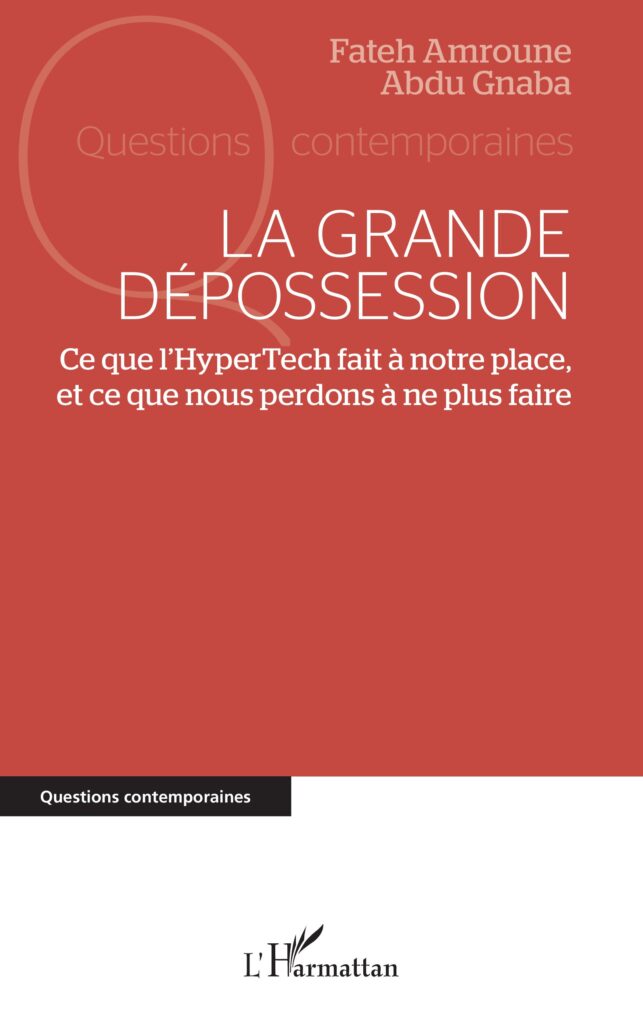
Abdu Gnaba and Fateh Amroune explore this problem in La Grande Dépossession. Their subject is what happens to people when they delegate activities through which they once learned to think. It is a question for anyone whose livelihood depends on judgement, including those deciding where to invest.
Abdu Gnaba studies the habits and relationships through which people find a place in society. An anthropologist with a doctorate from the Sorbonne, he founded SocioLab, the qualitative research consultancy based in Luxembourg and Paris, and teaches at ESSEC. He is a former France Inter columnist and the author of Anthropologie des mangeurs de pain and Bricole-moi un mouton, published by L’Harmattan.
Fateh Amroune is an engineer and entrepreneur based in Luxembourg, with twenty-five years of experience in digital transformation across Europe. Previously a director at Deloitte Luxembourg, he led the launch of the Luxembourg AI Factory at Luxinnovation, the national innovation agency. He also founded CogniScore and teaches on the MBA programme at HEC Liège.
Their conversations give the book much of its character. They disagree often enough to make the exchanges worth following. Fateh Amroune will defend a tool’s usefulness; Abdu Gnaba will ask what happens to the person using it. The objections sometimes run the other way, and neither author gets to keep an entirely comfortable position for long.
The title may sound ominous. Abdu Gnaba, though, describes the arrival of these technologies as an opportunity to question our humanity. There is something appealing about that response. An invention that unsettles our confidence in our own intelligence might also make us more curious about it.
The authors turn to Renaissance humanism to explore this thought. Montaigne is particularly helpful here. Writing the Essays was a way of finding out what he thought, and of changing his mind along the way. The work mattered to the person doing it. That remains a familiar experience for anyone who has understood a difficult decision only after struggling to put it into words.
The book makes an important distinction about effort. Some of it is simply a burden, and removing it is a considerable benefit. Other kinds of effort develop the abilities we later take for granted. Experience is hard to acquire if the work through which people once gained it has been done for them.
This has consequences for an employer. A young colleague who produces an excellent report with AI may still need help learning to recognise a weak argument. An experienced manager who regularly accepts a well-presented recommendation needs enough time and confidence to question its premises. Neither problem is solved by requiring a human signature at the end of the process.
Fateh Amroune and Abdu Gnaba give this situation a memorable name: the “inverted centaur”. The human appears to be in charge, while the machine increasingly sets the direction. A full diary and a succession of successful approvals could make that change quite difficult to notice.
In Luxembourg’s professional services businesses, much of what clients pay for is experienced judgement. That gives the argument a particular relevance here. A firm can become quicker at delivering work while gradually weakening the expertise that made its advice worth buying. The effect may take longer to show up than the saving in staff hours.
For an investor, this suggests a useful line of enquiry. Alongside the productivity figures, look at how the business develops its people and preserves its ability to challenge the tools it uses. Its relationship with technology suppliers matters too. Access to a powerful model is less of an advantage when competitors can buy the same access, and dependence becomes expensive if the supplier gains the upper hand.
The authors are also interested in what happens to the time we save. Two doctors in the book use the same software to write up consultations. One sees more patients; the other makes the appointments longer. Both choices are understandable. The difference owes something to personal preference, but also to the way a practice is funded and the pressures on its owner. The example gives an employer plenty to think about before announcing the next efficiency programme.
Work on the book has already led to a practical venture. Fateh Amroune presents CogniScore as an outcome of the authors’ discussions: a “Nutriscore for software” offering an A-to-E assessment of digital services. Its criteria cover matters such as privacy, attention, transparency and AI trustworthiness. The ambition is to make practices that are difficult for users to see easier to judge.
There is a lovely complication in the book’s discussion of such a score. A rating can tell us something about how an application treats us today. What an experience will have taught us years from now is harder to capture. Even when they agree on a useful proposal, the authors keep finding more to discuss.
We have become accustomed to finding out what the latest AI system can do. There is rather less time to consider how we want to live and work with it, especially when everyone around us is under pressure to adopt it.
La Grande Dépossession gives that conversation some substance. It leaves the reader with a more demanding idea of progress, one in which people continue to learn and have a say in the lives they lead. Anyone entrusted with a business, or with the money invested in it, has a reason to spend time with that argument.
Fateh Amroune and Abdu Gnaba, La Grande Dépossession. Ce que l’HyperTech fait à notre place, et ce que nous perdons à ne plus faire. L’Harmattan, “Questions contemporaines”, 244 pages, €12. Publication: 12 November 2026. In French.
Read more articles:
Will Longevity Drive The Next Economic Revolution?
The First Luxembourgish Business School Earns AACSB Accreditation
Baker Tilly Luxembourg Joins Benelux Platform As New Leadership Takes Shape
