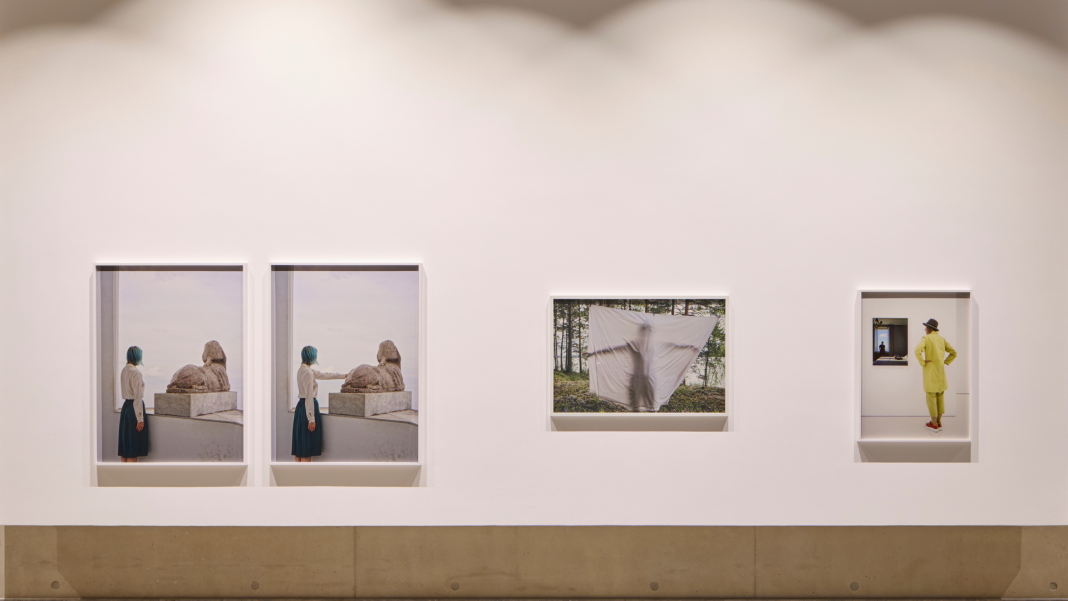
The Artist and Her Double brings together several decades of photographs in which Finnish artist Elina Brotherus explores identity, landscapes, and the relationship between the body and its surroundings. The exhibition is part of the Arendt & Art series and runs through 18 April 2027.
A self-described “chameleon”, Elina Brotherus herself figures into each of the photographs, although these aren’t self-portraits—she doesn’t refer to herself when describing each of them, rather uses terms like “the woman”, “the character” or “the human figure’.” As she explains, “They are somewhat fictional characters that embody something, but even I don’t always know what it is. It’s quite intuitive. I stage the character, and then things happen, but it’s independent of me.”
One of the defining features of her work is the careful construction behind each image. “These aren’t snapshots. What’s captured spontaneously is the scene where the photo unfolds, where the action takes place,” she explains. Working solo, Brotherus enjoys walking in nature, exploring places she isn’t familiar with.
As is evident from the collection, she gives careful consideration to aspects like natural lighting, colours and geometry, often with references connecting her images with art history and cultural memory. Baldessari in the Park (Triangular Figure with a Circle), 2021—a work likely to become a part of Arendt’s permanent collection—is an excellent example of these considerations. Taken at a castle in Normandy, France, where Brotherus had been invited to work during the covid-19 pandemic, a red beret atop the figure appears like a “dot”, similar to those used by artist John Baldessari, providing geometrical interest and serving as a focal point to the symmetry around it.
There are other references throughout the exhibition to, for instance, Joseph Beuys, Caspar David Friedrich, Francesca Woodman and Rene Magritte, transformed through Brotherus’ body and imagination. In another work, Beuys in an Exhibition, 2023, the image is taken in the Museum Schloss Moyland in Germany, which has the largest archive of Beuys’ works. “For this project, I wore the hat I had bought at a flea market years ago, and I became this kind of hybrid, or chimera, between men and women, between myself and Beuys,” Brotherus adds.
Nature occupies an important place in the exhibition. In one photograph, Marcello’s Theme, 2014, named after the artist’s dog that’s also in the image, a fallen tree becomes part of the composition rather than something to be removed. Brotherus donates regularly to forest conservation in Finland. “There’s nothing worse than cleaning up forests because they need dead wood for the insects that afterwards nourish the birds, etc. Nature does its work according to its own principles, so we don’t need to interfere too much.”
Another image—Tombeau imaginaire 26, version 1, 2019—comes from her series taken in Corsica, prompted by Brotherus’ reading German writer W. G. Sebald’s writing about the island, which remained unfinished at the time of his premature death. Through his writing, she learned about the historic burial practices on the island and the fact that the use of cemeteries only started in the 10th century. Brotherus travelled around Corsica, searching for landscapes beautiful enough to serve as imaginary resting places. It was a project that also became a tribute to her mother, who was born the same year as Sebald and became a widow at age 36, at which time she began an art school—something that Brotherus says also gave her the courage to, like her mother, follow an artistic path after having studied chemistry.
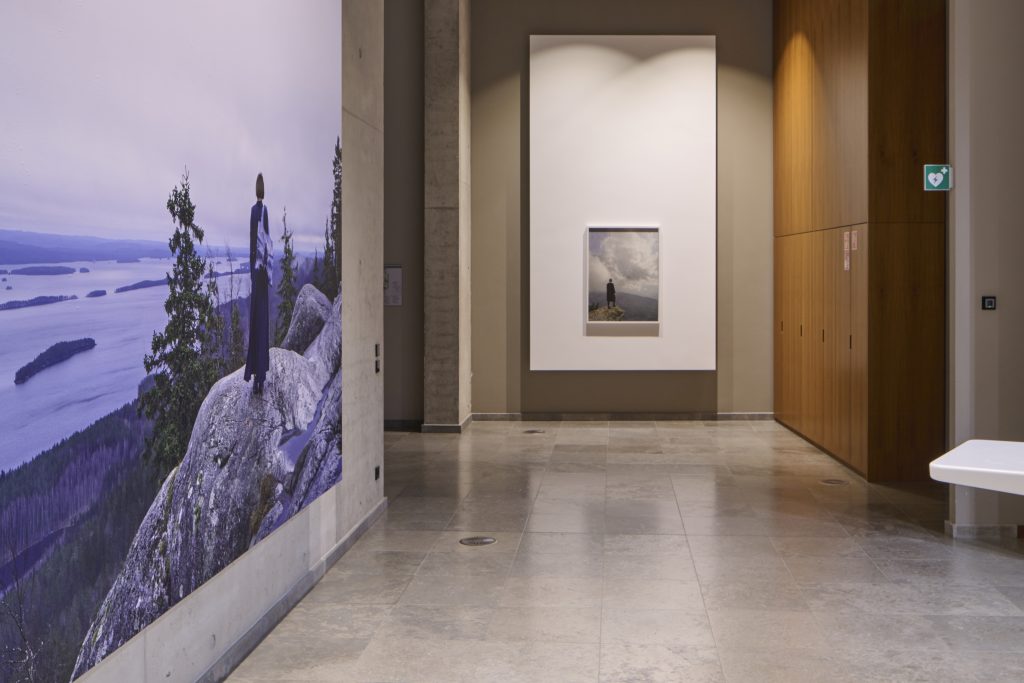
Running throughout the exhibition is also a persistent feminist perspective. Wanderlust, 2020 immediately calls to mind the Romantics and Friedrich’s solitary male figures standing before mountains and vast horizons. “I, too, wanted to be on the mountaintop!” Brotherus recalls thinking. “I want to put women in that place that has been, in history, reserved for men.” The artist advocates for better gender balance generally speaking, but also when it comes to cultural institutions, grants or exhibitions, etc. “If there isn’t parity, they need to go back to the selection process because it’s easy to overlook,” she adds. “We can’t do things like that anymore. We have to be very careful to be fair.”
For more information
The Artist and Her Double, curated by Claire and Paul di Felice, is open to the public until 18 April 2027, with visiting hours to the Arendt House on Saturday and Sunday, 9am-6pm. Read more about Arendt & Art here. To learn more about the artist, visit her website here.
Read more articles:
Luxembourg’s Fine Craftsmanship Steps Into the Light at Homo Faber in Venice
Friendship through Friendship: Runa Khan Bags ‘Nobel Prize of Asia’
Laurent Tapie: The Challenge Of Reviving Delage Through A Hypercar