
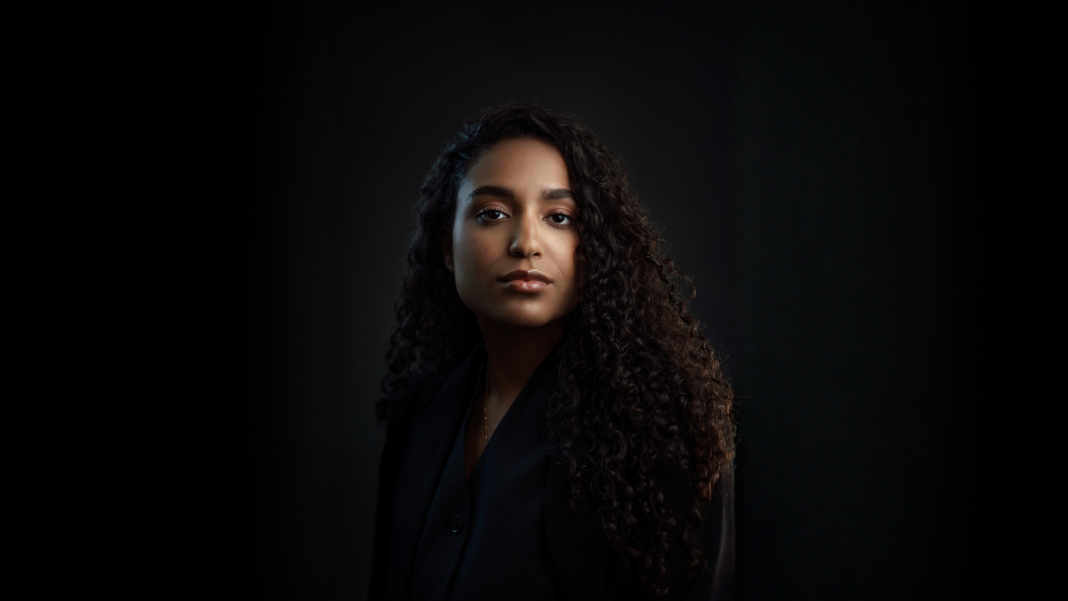
Nadia Kendall is a tireless advocate for people with non-visible disabilities and has helped bring the “Hidden Disabilities Sunflower” to Luxembourg. The global symbol is meant to allow wearers to share that they have a non-visible condition, a disability or a chronic illness, for instance, that might mean they need a little help or extra understanding. The network and cultural aspect around the Sunflower are more developed in other countries, she notes, but “it’s gained a lot of traction” in Luxembourg.
“I’m very justice-oriented,” says Kendall, describing what drives her on a daily basis. The executive director of Be Human, a non-profit association that aims to provide young women and under-represented groups with the skills needed to drive change, is a jurist and dedicated advocate for accessibility and human rights.
“I was always attracted to fighting for the rights of the under-represented,” she continues. Born in Orlando, Florida to Iranian and Caribbean parents, Kendall had a multicultural childhood. She spent five years in Qatar, then moved to Luxembourg at the age of 14. “As a result of my upbringing, and having heard stories of revolution and human rights, I grew up with a very strong sense of justice. I was interested in things like debate and climate change, and I went on to study political science at the University of Amsterdam.” She obtained an LLM at Tilburg University and at the University of Luxembourg and used her legal skills to advance diversity and inclusion initiatives in the corporate world before switching to the non-profit sector and joining Be Human.
It’s important to open up the conversation around disability rights in order to stimulate cultural and attitude shifts. “We’re having conversations about this, I’m hearing more actors discuss it, more non-profits are putting it on their agenda. It’s starting to cause a ripple effect,” she says. “I look forward to having other changemakers jump in with us, because we’re stronger together.”
Kendall was named Outstanding Youth Peaceworker at the 2024 edition of the Luxembourg Peace Prize for her work on boosting awareness and inclusion around hidden disabilities, and in October received the University of Luxembourg Student Initiative Award for her work on running the Hidden Disability Hub, a programme that helps young neuro-minorities advocate for themselves and build a support network.
As a woman of colour, adds Kendall, defending the under-represented and the marginalised and ensuring their visibility is an “extremely important” cause. “I never had representation looking like me growing up, until Michelle Obama,” she says. “She was the first woman of colour I saw on a screen. I was like, ‘Hey, so maybe we can do it too! Wow.’”
A word of advice? “Don’t bother with trying to prove people wrong. Just do it, and then they’ll realise you’re doing it!”
Passionate about the environment and sustainability, Kendall is an “electric car fanatic” and has an extensive collection of toy electric cars.
This article was published in the 8th edition of Forbes Luxembourg.
Read more articles:
Forbes Luxembourg Shines a Spotlight on Its First Ever Under 30 Honourees
